Boomers, Gen X, Millennials and Gen Z: Who Belongs to Which Generation?
Boomer, Gen X, Millennial or Gen Z? Here's who belongs to each generation, the commonly used birth years, where the names came from and why the dates sometimes differ.
By Ellie Hart — Commonplace
“Okay, Boomer.”
For a while, those two words seemed to be everywhere.
Then Millennials were blamed for killing everything from department stores to napkins. Generation X reminded everyone that it had been forgotten again. Gen Z arrived with TikTok, new slang and a seemingly endless ability to make the rest of us feel old.
We use generational labels constantly.
But who actually belongs to which generation?
The answer is a little messier than you might expect.
The Generations at a Glance
There isn't an official government authority that decides when one generation ends and another begins. Researchers and organizations sometimes use slightly different dates.
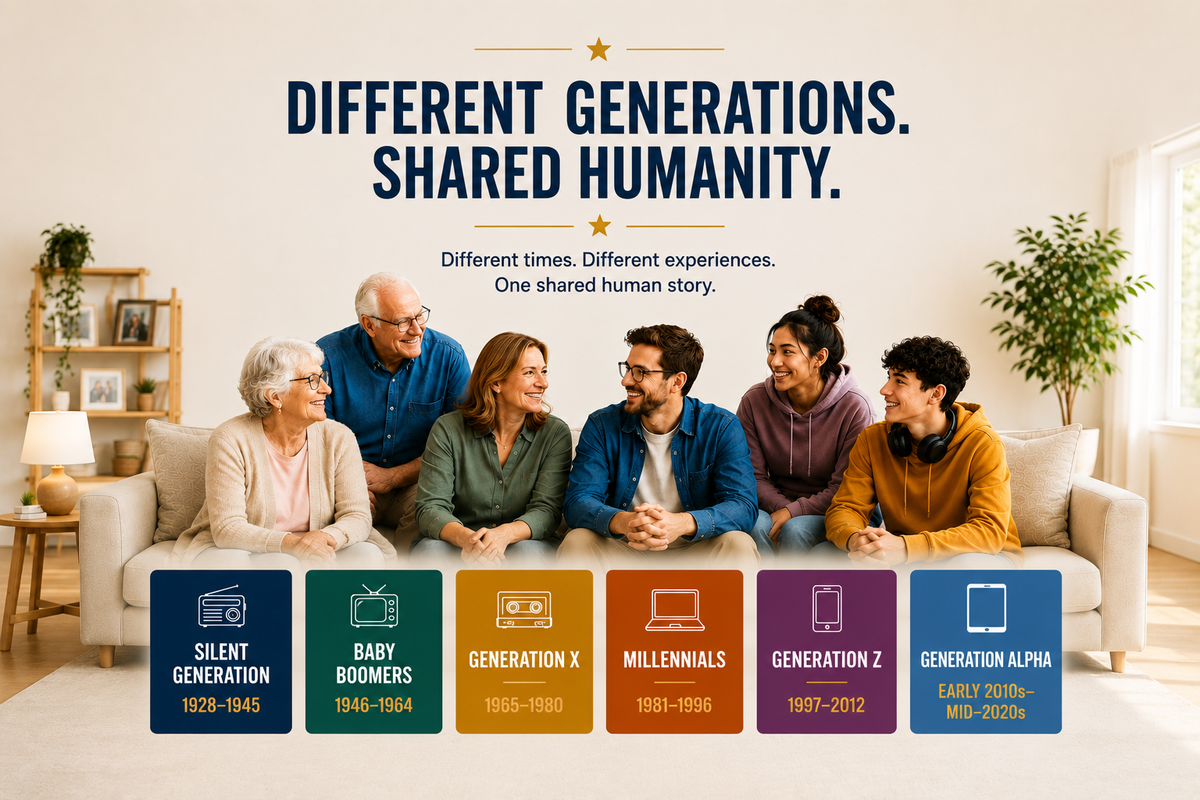
But these are commonly used ranges:
Silent Generation: 1928–1945
Baby Boomers: 1946–1964
Generation X: 1965–1980
Millennials: 1981–1996
Generation Z: 1997–2012
Generation Alpha: generally early 2010s through the mid-2020s
If you were born near one of those dividing lines, don't be surprised if another source places you in the neighboring generation.
Generations aren't scientific categories.
They're a way of talking about groups of people who experienced roughly the same period of history at similar stages of life.
The Silent Generation
Born approximately 1928–1945
Members of the Silent Generation grew up during the Great Depression, World War II or the years immediately surrounding them.
The name became associated with a generation often characterized as cautious and conformist, although that description hardly fits everyone born during those years.
They came of age before television dominated American homes, when newspapers and radio were central sources of information.
Today, they're the oldest generation with a significant living population.
Baby Boomers
Born 1946–1964
This one's name has a very literal origin.
After World War II, the United States experienced an enormous increase in births—the baby boom.
Boomers grew up during tremendous cultural change: television, rock 'n' roll, the civil rights movement, Vietnam, the space race and the counterculture of the 1960s.
They also became such a large demographic group that their influence followed them throughout American life, affecting everything from schools and housing to politics and retirement.
And despite internet shorthand, “Boomer” does not simply mean anyone older than you.
Generation X
Born 1965–1980
Generation X sits between two much larger and more frequently discussed generations.
Which is somehow very Gen X.
They were the kids of cable television, arcades, MTV, early home computers and the transition from analog life toward the digital world.
Many Gen Xers remember childhood without the internet but adopted it as adults.
They're sometimes called the latchkey generation, reflecting a period when more children returned from school to empty homes as both parents worked.
They also gave us grunge.
You're welcome.
The difference between Gen X and Millennials goes far beyond birth years. Take a closer look at what separates Gen X from Millennials, and what the two generations have in common.
Millennials
Born 1981–1996
Millennials got their name because the oldest members reached adulthood around the turn of the millennium.
They're also sometimes called Generation Y, because they followed Generation X.
Millennials grew up during an extraordinary technological transition. Many remember landline phones, dial-up internet and VHS tapes—but entered adulthood alongside smartphones, social media and an increasingly online economy.
The September 11 attacks and the Great Recession were major formative events for many members of the generation.
And despite the way the word is sometimes used, Millennials aren't college kids anymore.
In 2026, the oldest Millennials are in their mid-40s.
Yes.
We'll give everyone a moment.
Generation Z
Born approximately 1997–2012
Gen Z is the first generation for whom an internet-connected world was largely a childhood expectation rather than an innovation.
Smartphones, streaming video and social media were part of everyday life for much of their formative years.
Members of Gen Z have also grown up amid the Great Recession's aftermath, intense political polarization and the COVID-19 pandemic.
They're now entering adulthood, higher education and the workforce in substantial numbers.
And just as Millennials once became shorthand for “young people,” Gen Z has increasingly taken over that role.
Eventually, someone younger will do the same thing to them.
That's how this works.
Generation Alpha
Born beginning in the early 2010s
Generation Alpha follows Gen Z, although researchers differ about its precise starting and ending years.
These are children growing up with tablets, streaming entertainment, smart devices and artificial intelligence as ordinary parts of life.
For them, asking a digital assistant a question may seem about as remarkable as using a microwave did to earlier generations.
We don't yet know what will ultimately define Generation Alpha.
That's because generations usually become easier to understand after we've watched them grow up.
Why Don't the Dates Always Match?
Because generations don't change at midnight on January 1.
A person born in December 1996 didn't experience an entirely different childhood from someone born in January 1997.
Researchers choose boundaries because categories are useful for studying populations and discussing cultural change.
But those boundaries are ultimately human inventions.
People born near the edges sometimes even identify more strongly with the neighboring generation. That's why you'll occasionally hear informal labels such as Xennials for people caught between Generation X and Millennials.
Generations Explain Something—Not Everything
Generational categories can help us understand shared experiences.
Someone who remembers the moon landing experienced a different childhood from someone who watched September 11 unfold at school—and both experienced something different from a child whose classroom moved onto Zoom during the pandemic.
Those experiences matter.
But generation isn't destiny.
Not every Boomer struggles with technology. Not every Gen Xer is cynical. Not every Millennial lives on social media. Not every member of Gen Z communicates exclusively through memes.
We're shaped by families, geography, economics, culture, personality and countless other things besides the year printed on our birth certificates.
Generational labels are useful when they help us understand one another.
They're considerably less useful when they become stereotypes.
So the next time someone complains about Millennials, Boomers, Gen X or Gen Z, at least you'll know who they're actually talking about.
Whether the complaint makes any sense is another matter entirely.