The Return of the Third Place: Why We’re Looking for Somewhere to Belong Again
There was a time when you could walk into a neighborhood diner and the waitress might already be pouring your coffee.
By Eleanor “Ellie” Hart | Commonplace
You knew which stool you preferred. You recognized the couple in the corner booth, even if you had never learned their names. Someone behind the counter noticed if you hadn't been in for a while.
Nothing particularly important happened there.
And perhaps that was precisely what made it important.
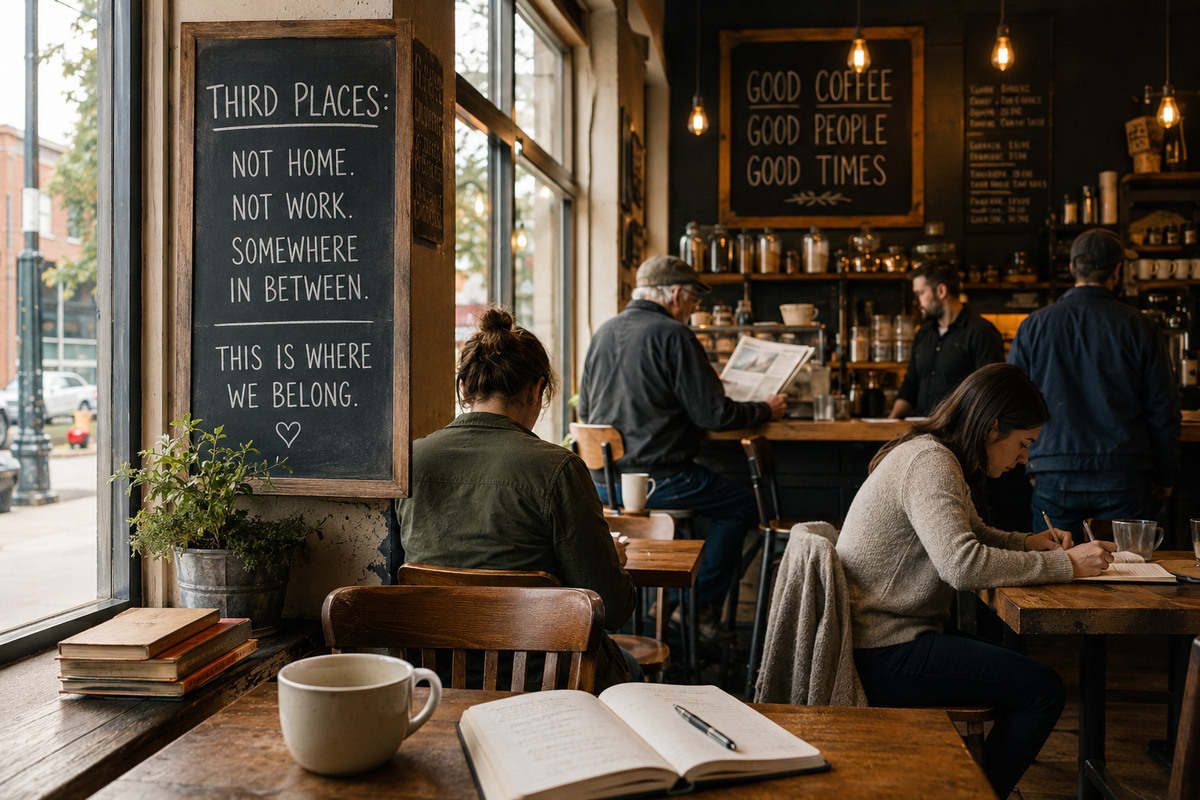
Sociologists have a name for places like these: third places. Home is the first place. Work is the second. The third place is somewhere else entirely — the coffee shop, library, barbershop, church fellowship hall, bookstore, neighborhood pub or park where people gather without necessarily having a reason to.
For much of modern life, these places quietly stitched communities together.
Then, somewhere along the way, many of us stopped going.
When Convenience Changed Everything
We have become remarkably good at eliminating the need to leave home.
Dinner can arrive at the door. Groceries can appear on the porch. A movie theater's catalog lives inside the television. Meetings happen on laptops. Shopping happens on phones. Even friendships can be maintained through a stream of photographs, messages and reactions.
There is much to appreciate about that convenience.
But convenience has a hidden cost: it removes encounters.
Ordering coffee through an app eliminates the conversation at the counter. Working from home eliminates the person you used to see in the elevator every morning. Online shopping eliminates the familiar clerk at the neighborhood store.
None of those interactions seems particularly significant on its own.
Collectively, they form something much larger.
They create the feeling that we live among other people.
The person who remembers your order isn't necessarily your friend. The neighbor who waves while walking the dog may know almost nothing about your life. The librarian who recognizes you might never see you anywhere outside the library.
Yet these small recognitions tell us something surprisingly powerful:
You are part of this place.
We May Be Missing More Than People
When we talk about loneliness, we usually talk about relationships.
Do we have close friends? Family nearby? Someone to call when things go wrong?
Those relationships matter enormously.
But belonging has another layer that is easier to overlook. Human beings also seem to need what might be called familiar strangers — people we encounter repeatedly without necessarily becoming close to them.
The same cashier.
The same person reading near the window.
The same group occupying the large table every Saturday morning.
Over time, strangers become familiar simply because everyone keeps showing up.
And showing up matters.
A community isn't created only through deep relationships. Sometimes it begins with repetition.
Same place.
Same faces.
Same time next week.
The Coffee Shop Isn't Really About Coffee
This may help explain why certain places inspire such fierce loyalty.
There are cheaper ways to make coffee than buying it from a café. There are easier ways to read a book than driving to a library. There are more convenient ways to watch a football game than sitting in a neighborhood bar.
But efficiency isn't always the point.
Sometimes we go somewhere simply because other people are there.
Look around a busy coffee shop and you'll see a peculiar collection of modern life. Someone is working on a laptop. Two friends are talking. A retired man is reading the newspaper. A mother is negotiating with a toddler. A student has been staring at the same textbook page for twenty minutes.
Most of these people will never speak to one another.
Still, they are sharing something.
For an hour or two, they are participating in the same little corner of the world.
That experience cannot quite be delivered to your front door.
Why Third Places Feel Different
The best third places generally have something in common: they don't require much from us.
You don't have to host anyone.
You don't have to clean the house before arriving.
You don't need an agenda.
You aren't responsible for entertaining everybody.
You simply appear.
That simplicity can feel almost radical in a culture that increasingly asks us to schedule everything.
Friendship becomes a calendar invitation. Family conversations become group texts. Even recreation sometimes feels like another task to organize.
Third places allow something different.
They create the possibility of unplanned life.
You might run into someone.
You might have a conversation.
You might sit quietly for an hour and have no conversation whatsoever.
All three are acceptable.
The Places Are Still Here
The encouraging thing is that third places haven't disappeared.
Libraries are still there.
Independent bookstores still host readings and conversations. Coffee shops still have regulars. Churches still hold dinners. Parks still fill with walkers in the evening. Diners still have people sitting at counters.
There are newer versions, too.
Coworking spaces sometimes serve the same purpose. So do community gardens, hobby groups, farmers markets and neighborhood events.
Even some online communities eventually create physical gatherings because, after enough messages and video calls, people still want to sit across a table from one another.
Technology can connect us extraordinarily well.
But eventually someone says:
We should get together sometime.
There may be something important hidden inside that sentence.
Becoming a Regular Again
Perhaps rebuilding community doesn't always require a grand initiative.
Maybe it begins much smaller.
Choose a place.
Go there regularly.
Put the phone away occasionally.
Learn someone's name.
Say hello to the person you keep seeing.
Become recognizable.
The strange thing about belonging is that we often imagine someone else must create it for us. We wait to be invited into a community that already exists.
But communities are frequently built by people doing something far less dramatic.
They keep showing up.
There is comfort in walking into a place and recognizing the room. There is even greater comfort when the room begins to recognize you.
The old neighborhood diner wasn't special because the coffee was extraordinary.
It was special because someone saw you come through the door, reached for a cup and said:
“Good morning. Haven't seen you in a few days.”
Maybe that's one of the things we're looking for again.
Not another place to go.
A place where our absence might eventually be noticed.