Why We Miss Places That No Longer Exist
We do not always miss an old restaurant, house or theater because it was extraordinary. We miss the version of ourselves that once lived there.
By Eleanor “Ellie” Hart | Commonplace
The restaurant closed. The house was sold. The old department store became something else. Yet part of us still expects everything to be there.
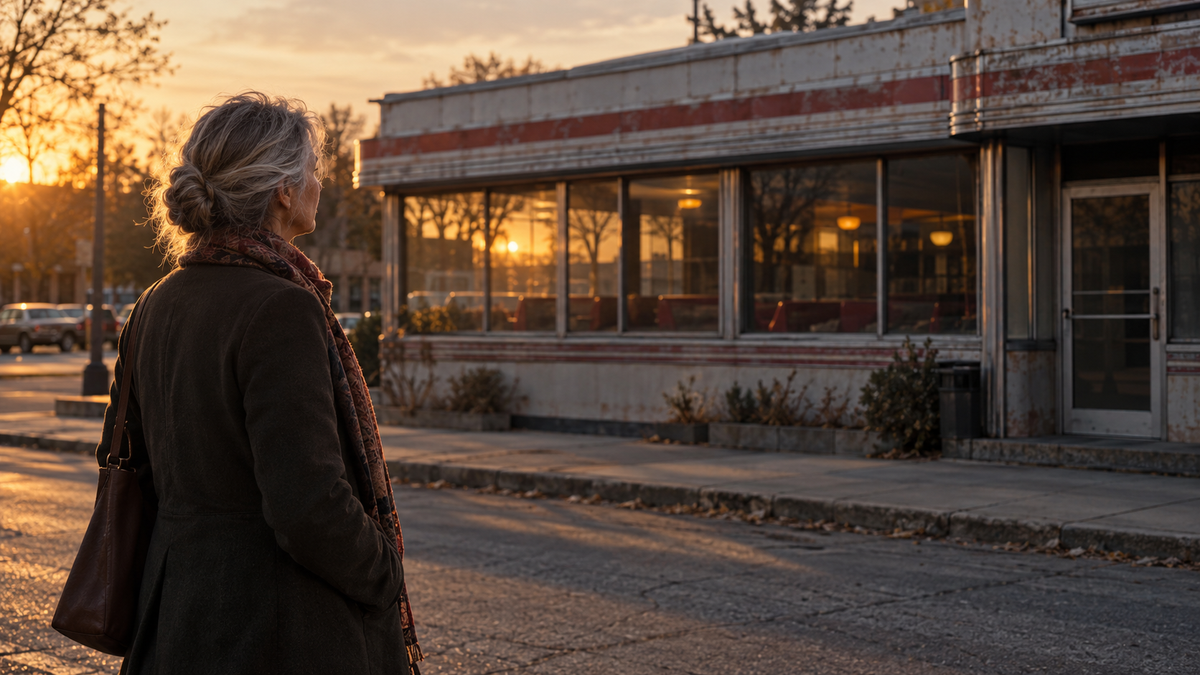
There was a small restaurant in the town where I grew up that served coffee in thick white cups and put a glass bowl of crackers on every table.
The food was fine. Not extraordinary. The booths were patched with tape, the menu rarely changed and nobody would have driven an hour to eat there.
But years after it closed, people still talk about it.
They remember where their parents sat on Sunday mornings. They remember the waitress who called everyone “hon.” They remember being 10 years old and spinning on a stool while their father paid at the register.
What they miss is not really the restaurant.
They miss who they were when the restaurant was still there.
We tend to believe nostalgia is about wanting old things back. Sometimes it is. But more often, we miss places because they held versions of our lives that we can no longer visit.
A childhood home may have been cramped. The mall where we spent our teenage years may have been loud and ugly. The office where we worked for 20 years may have contained fluorescent lights, bad coffee and at least one person we deliberately avoided in the hallway.
Then the house is sold. The mall is demolished. The company moves. Suddenly, the flaws become less important than the fact that a door has closed.
The places that surround us become quiet witnesses to our lives.
They saw us before we knew what we were doing. They held our ordinary Tuesdays, our awkward first dates, our family arguments and our celebrations. They were the backgrounds of moments we did not realize we would someday treasure.
That may be why the loss of an ordinary place can surprise us.
You drive past a vacant lot where a movie theater once stood, and for a second you can almost see the marquee again. You remember the person who sat beside you, the film you barely recall and the enormous box of popcorn you could not afford but bought anyway.
The theater itself was never sacred. The memory became sacred because time moved on.
There is also something unsettling about discovering that a place continued without us—or disappeared entirely.
We like to imagine that the rooms of our past remain frozen after we leave them. Somewhere, perhaps, our childhood bedroom still has the same wallpaper. The corner store still has the bell above the door. The church fellowship hall still smells like coffee and sheet cake.
Of course, it does not work that way.
Someone painted the bedroom. The corner store became a pharmacy. The church replaced the folding tables and remodeled the kitchen. Places change because the people inside them keep living.
Still, seeing that change can feel like losing the memory itself.
It is not.
The building may be gone, but the life that happened there cannot be demolished with it.
Your grandmother still stood at that stove. Your children still ran through that backyard. You still laughed until closing time in that booth by the window. None of it becomes less real because another family owns the house or a parking garage occupies the block.
Maybe that is what photographs try to tell us. We take pictures of people, but we are also preserving places—the porch behind them, the curtains, the old sofa, the car in the driveway.
Years later, our eyes wander away from the smiling faces and toward the details we once ignored.
“Look at that kitchen,” we say.
“I forgot about that lamp.”
“Do you remember the sound that screen door made?”
The most ordinary details become precious because they prove that the world we remember existed somewhere beyond our imagination.
Not every vanished place deserves to return. Some buildings were uncomfortable. Some neighborhoods excluded people. Some traditions looked better through the forgiving haze of memory than they ever did in real life.
Nostalgia can soften the edges of the past, but it should not erase them.
We can remember warmly without pretending everything was better. We can miss the local store while appreciating the convenience of what replaced it. We can love the house where our family lived while admitting that the roof leaked every spring.
Missing a place is not necessarily a demand to go backward.
It is often a way of honoring what happened there.
Perhaps that is why we sometimes take the long route through an old neighborhood or slow down when passing the exit for a town where we once lived. We are not expecting to recover the past. We simply want to stand near it for a moment.
We want to say: I remember this. I was here. This mattered to me.
The world will continue replacing diners, schools, houses, theaters and familiar stretches of road. New people will build their own memories where ours once lived.
That is not a betrayal. It is what places are for.
They hold us for a while. Then they hold someone else.
And when they disappear, we carry them.