Apple’s September Event Could Be Its Most Important in Years
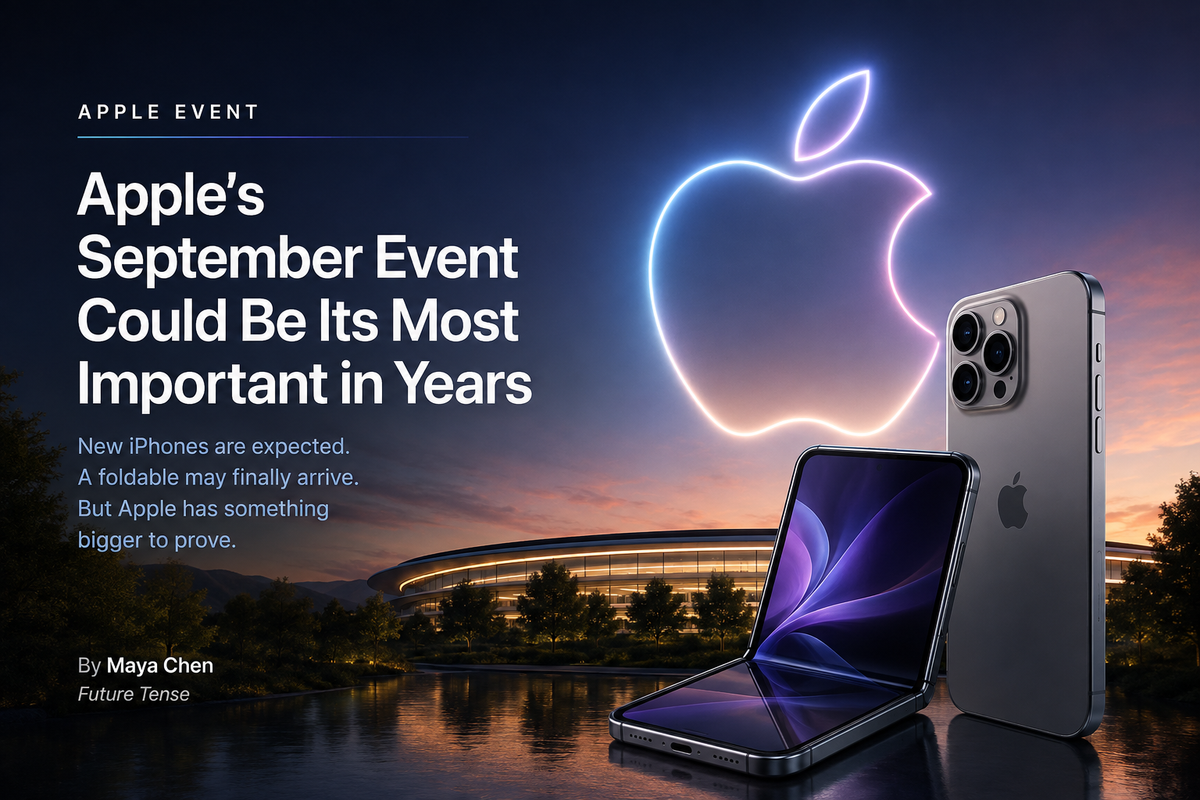
New iPhones are expected. A foldable may finally arrive. But Apple has something bigger to prove.
By Maya Chen | Future Tense
Apple has spent decades perfecting a particular kind of product launch.
Lights down. Carefully produced video. Beautiful hardware rotating against an impossibly clean background. A new chip is faster. A camera is better. A screen is brighter. And somewhere along the way, we're told that this is the best iPhone Apple has ever made.
On September 9, Apple will do it again.
But this time feels different.
Apple has officially scheduled its next special event for September 9 at 10 a.m. Pacific. The company isn't saying exactly what it will unveil, but the annual September event has become synonymous with the next generation of iPhone.
The most intriguing possibility, however, isn't simply another iPhone.
It's an iPhone that folds.
Reports ahead of the event suggest Apple may finally enter the foldable-phone market, an increasingly important corner of the smartphone business that competitors—most notably Samsung—have been developing for years.
If it happens, Apple's arrival would be characteristically late.
And that may be exactly the point.
Apple Rarely Needs to Be First
Apple has built one of the world's most valuable technology businesses without consistently being the first company to introduce a new technology.
There were smartphones before the iPhone. Tablets before the iPad. Smartwatches before the Apple Watch. Wireless earbuds before AirPods.
Apple's specialty has traditionally been something else: waiting until a technology is mature enough, then packaging it into a product ordinary consumers actually want to use.
A foldable iPhone would put that strategy to the test again.
Foldable phones have moved well beyond the experimental stage, but they remain relatively expensive and unusual compared with traditional smartphones. Apple entering the category could be the moment folding devices move from technological curiosity to mainstream consideration.
But Apple would have to answer the most important question:
Why should your phone fold in the first place?
A clever hinge isn't enough.
Apple will need to demonstrate that opening a phone into a larger display meaningfully improves what people can do with it.
The iPhone Still Matters—A Lot
It's easy to talk about artificial intelligence, spatial computing and whatever technological revolution is supposedly arriving next.
But Apple's business still revolves heavily around the device millions of people carry in their pockets.
The iPhone is more than a product. It is the center of an ecosystem connecting the Apple Watch, AirPods, Macs, iPads, services and increasingly Apple's artificial-intelligence ambitions.
That makes every major iPhone launch important.
It also makes innovation increasingly difficult.
Today's smartphones are remarkably mature. Cameras improve. Processors get faster. Batteries last longer. Screens get brighter.
Those are meaningful improvements, but they're rarely transformative anymore.
A foldable device gives Apple something the smartphone industry hasn't had much of lately: a visibly different idea.
Whether it's a better idea remains to be seen.
Then There's AI
The other story hanging over Apple's event is artificial intelligence.
Apple has been trying to define its place in an industry suddenly obsessed with AI. The company's advantage is enormous: hundreds of millions of devices already in people's hands.
Its challenge is equally significant.
Consumers aren't buying "AI." They're buying things that hopefully make their lives easier.
Apple therefore has to turn artificial intelligence from a collection of impressive demonstrations into useful everyday experiences.
Can your phone understand what you're trying to accomplish?
Can it help without constantly getting in the way?
Can it use personal information while protecting your privacy?
And perhaps most importantly, can Apple make AI feel less like another technology product and more like something naturally built into the devices we already use?
Those questions may ultimately matter more than another processor benchmark.
A Changing Apple
There's another reason September 9 deserves attention.
Apple is entering a new leadership era, with longtime hardware executive John Ternus preparing to take the company's top job as Tim Cook transitions to executive chairman.
Leadership changes at companies this large don't instantly transform products. The devices appearing onstage this September have been under development for years.
But symbolism matters.
For more than a decade, Cook's Apple has been defined by extraordinary operational discipline, ecosystem growth and refinement of the product categories created or established during the Steve Jobs era.
The question for Apple's next chapter is whether refinement remains enough.
A foldable iPhone, a stronger push into AI and whatever else Apple has waiting backstage could offer the first clues.
What I'll Be Watching
I'm less interested in whether the next iPhone has another megapixel or a slightly faster processor.
I want to see whether Apple can make technology feel surprising again.
If there's a foldable iPhone, show us why folding matters.
If AI is the future of Apple's software, show us something genuinely useful.
If this is the beginning of a new era for the company, give consumers a reason to notice.
Apple doesn't need another revolutionary product every September.
That's an impossible standard for any company.
But every once in a while, it needs to remind us why people once rearranged their schedules just to see what Apple was going to announce next.
September 9 would be a very good time to do it.