Your Favorite New Artist May Be Competing With Bots
Fake streams are stealing royalties, distorting popularity and making it harder to know which artists people actually love. The music industry says it finally has a plan to fight back.
By Jack Sullivan | After Credits
The next breakout music star may have talent, charisma and a devoted fan base.
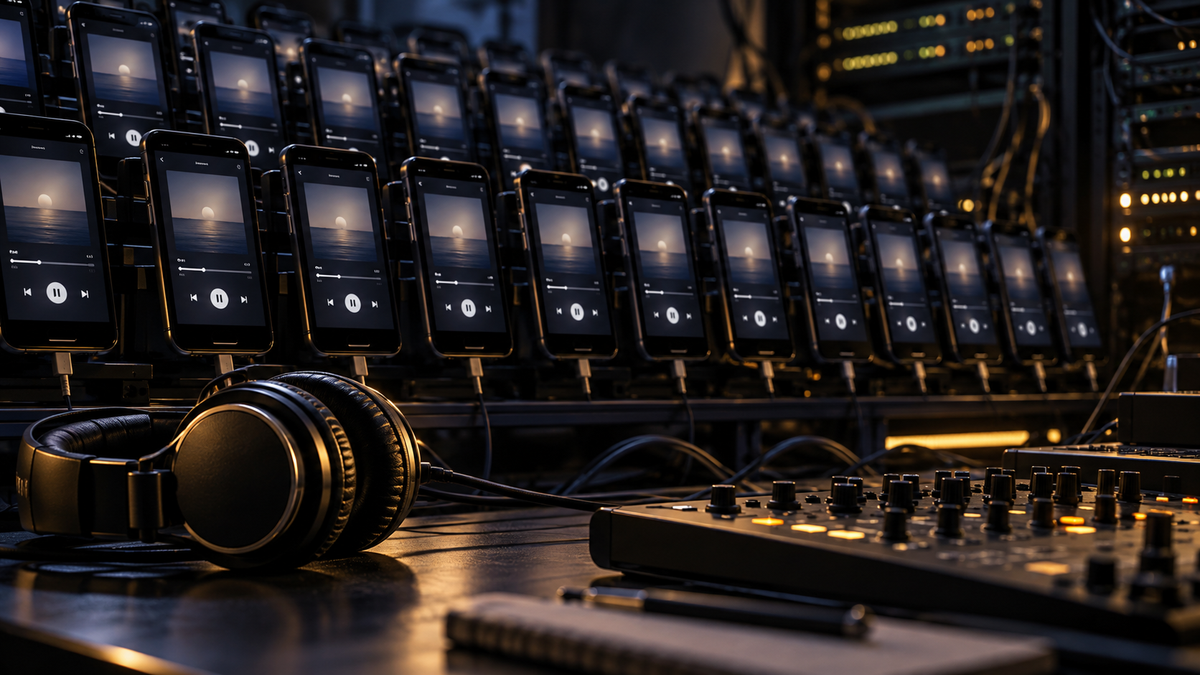
Or they may have a warehouse full of phones playing the same song all night.
Streaming fraud has become serious enough that major music companies, independent labels and distribution services are joining forces to fight it. The newly announced Streaming Integrity Initiative establishes common practices for identifying fake music, artificial plays and the people profiting from them.
That sounds technical. The scam itself is not.
Someone uploads music to a streaming service. Then armies of automated accounts repeatedly play it. Those fake streams generate real royalty payments while making the music appear more popular than it actually is.
It is payola for the algorithm age.
Fake Plays Take Real Money
Most streaming services collect subscription and advertising revenue before distributing portions of it to rights holders. When fraudulent songs generate millions of artificial plays, they can siphon money away from legitimate musicians whose songs were played by actual people.
For small and independent artists, every fraction of that royalty pool matters.
But money is only part of the problem.
Streaming numbers have become cultural currency. Play counts help fans decide which artists deserve attention. They can influence playlists, promotion, media coverage and industry interest.
Once those numbers can be purchased or manufactured, popularity becomes another product for sale.
The industry is no longer just asking whether a song is good. It must also ask whether anyone actually listened to it.
The Industry Has a Plan
The Streaming Integrity Initiative asks music distributors to verify customer identities and ownership rights, screen suspicious content, investigate suspected fraud and share information about repeat offenders.
Sony Music, Universal Music Group, Warner Music Group, CD Baby, The Orchard and numerous other companies are supporting the effort.
That is an impressive list. It is also a voluntary industry commitment, not a magic switch.
Fraudsters adapt quickly. Artificial intelligence can produce enormous quantities of inexpensive music, while bots can play it around the clock. When one account disappears, another can take its place.
The companies fighting the fraud also benefit from the streaming economy they are promising to clean up. Listeners will have to trust them to investigate their own system and tell us when it fails.
Was That Song Actually a Hit?
Music has always contained manufactured success. Radio stations had payola. Record labels bought promotion. Managers found creative ways to push albums onto the charts.
Streaming promised something cleaner. Listeners would choose what became popular.
Now even the listeners can be fake.
The good news is that the industry is finally treating streaming fraud as more than a technical nuisance. The bad news is that nobody knows how much artificial activity has already shaped the music we were told everyone loved.
The next time a mysterious artist appears with millions of plays, the question may not be, “How did I miss this?”
It may be, “Did anyone else actually hear it?”