25 Movies Everyone Should See at Least Once
From The Godfather and Casablanca to Jurassic Park and The Matrix, here are 25 movies everyone should experience at least once—and why each one deserves a spot on your watchlist.
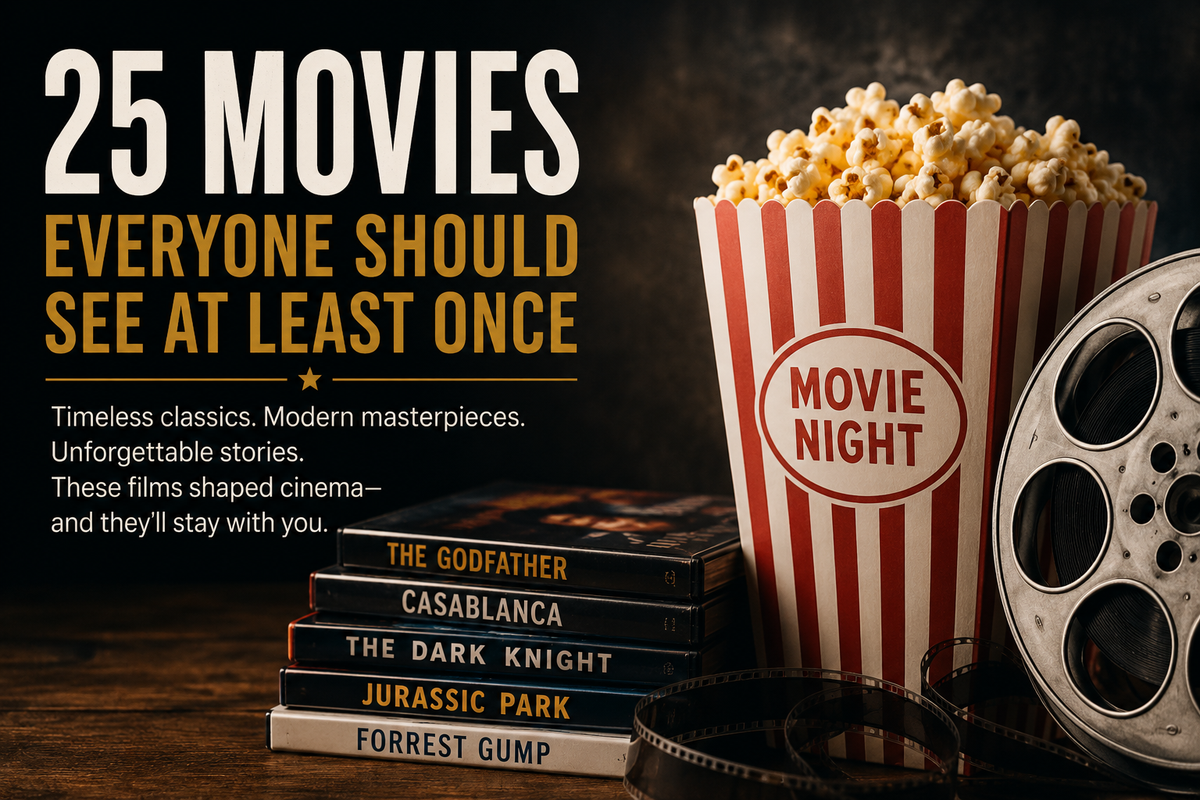
By Jack Sullivan — After Credits
There is no such thing as a perfect list of the greatest movies ever made.
Put ten movie lovers in a room, ask them to name the best film of all time, and you'll probably get twelve answers and at least one argument.
So this isn't a ranking.
These are movies I think everyone should experience at least once—not necessarily because they're flawless, but because they did something memorable. Some changed filmmaking. Some became part of our cultural vocabulary. Some are simply so entertaining that missing them feels like leaving a chapter out of your movie education.
The American Film Institute has spent decades creating its own lists celebrating influential American cinema, while the Library of Congress preserves films considered culturally, historically or aesthetically significant.
My criteria are considerably less scientific.
Did the movie matter? And is it still worth sitting down to watch?
Here are my 25.
1. The Godfather (1972)
Forget the gangster label for a moment. The Godfather is really about family, loyalty, power and the gradual corruption of a man who believed he could remain outside his family's world. It's patient, beautifully acted and enormously influential.
2. Casablanca (1942)
Some classics feel like homework. Casablanca doesn't. Beneath all those famous lines is a remarkably human story about love, sacrifice and choosing something larger than yourself.
3. Jaws (1975)
Steven Spielberg demonstrated just how terrifying something can be when you don't see it. Jaws is suspense filmmaking at its simplest and best—and it helped redefine the Hollywood summer blockbuster.
4. The Shawshank Redemption (1994)
A prison movie that ultimately isn't about prison. It's about friendship, dignity, endurance and hope. There's a reason people keep discovering it and then watching it again.
5. Star Wars (1977)
You can debate which Star Wars movie is best. But the original changed popular cinema. George Lucas combined mythology, science fiction, adventure and groundbreaking effects into something audiences hadn't experienced quite like this before.
6. The Wizard of Oz (1939)
Nearly a century later, people who haven't even seen the movie recognize its characters, songs and imagery. Few films have embedded themselves so completely into American culture.
7. Schindler's List (1993)
Not an easy movie. Not supposed to be. Spielberg's Holocaust drama is devastating precisely because it constantly brings an almost incomprehensible historical atrocity back to individual human lives.
8. Rocky (1976)
Yes, there's boxing. But Rocky isn't really about winning a fight. It's about an ordinary person wanting one opportunity to prove—to himself more than anyone else—that his life means something.
9. The Silence of the Lambs (1991)
A thriller built as much around conversation as violence. Anthony Hopkins' Hannibal Lecter became an icon, but Jodie Foster's Clarice Starling is the reason the movie has a heart.
10. It's a Wonderful Life (1946)
Its reputation as a sentimental Christmas movie undersells it. George Bailey's story gets surprisingly dark before arriving at its famous conclusion about the value one ordinary life can have.
11. Jurassic Park (1993)
There's a moment when the dinosaurs first appear and the characters simply stare.
So did we.
More than three decades later, Jurassic Park remains a terrific example of spectacle working because the movie gives us characters and wonder before unleashing the chaos.
12. 12 Angry Men (1957)
Twelve men. One room. Mostly conversation.
That's about it.
And it's riveting.
If you want proof that storytelling doesn't require enormous budgets or special effects, start here.
13. Psycho (1960)
Alfred Hitchcock spends much of Psycho teaching the audience what kind of movie they're watching—and then proves them wrong. Its influence on thrillers and horror movies is difficult to overstate.
14. Back to the Future (1985)
One of those rare movies where nearly everything introduced early matters later. Funny, inventive and enormously rewatchable, it's practically a master class in setup and payoff.
15. E.T. the Extra-Terrestrial (1982)
An alien comes to Earth, but the spaceship isn't really the point. E.T. works because Spielberg tells the story largely through a child's emotional world: loneliness, friendship, wonder and eventually loss.
16. Goodfellas (1990)
If The Godfather presents organized crime as an American tragedy, Goodfellas shows you the seductive rush before everything starts collapsing. Martin Scorsese makes the lifestyle attractive enough that you understand why someone would want in—and frightening enough that you're relieved you aren't.
17. The Exorcist (1973)
Plenty of movies can make you jump.
The Exorcist gets under your skin.
Its seriousness about faith, doubt, evil and desperation is one reason it still feels different from countless supernatural horror movies that followed.
18. Saving Private Ryan (1998)
The opening combat sequence is unforgettable, but the movie's deeper question comes afterward: What does one life owe to the people who sacrificed theirs to save it?
19. The Princess Bride (1987)
Adventure. Romance. Comedy. Sword fighting. Revenge.
And somehow none of it feels like it belongs to a different movie.
It's endlessly quotable without needing its quotations to carry it.
20. Alien (1979)
Part science fiction, part horror movie, part haunted-house story in space. Ridley Scott understood that a monster becomes considerably more frightening when you're trapped somewhere with it.
21. One Flew Over the Cuckoo's Nest (1975)
Funny, rebellious and ultimately heartbreaking. Jack Nicholson's McMurphy arrives believing he can beat the system through sheer force of personality. The movie gradually asks what happens when the system is stronger.
22. The Dark Knight (2008)
Christopher Nolan demonstrated that a superhero movie could also function as a crime epic about morality, chaos and the limits of heroism. Heath Ledger's Joker became one of modern cinema's defining villains.
23. Toy Story (1995)
The technology was revolutionary, but that's not why Toy Story lasted.
It lasted because Woody was jealous.
Pixar understood from the beginning that technological innovation gets people into the theater. Characters make them care.
24. The Matrix (1999)
Some movies influence what comes after them so heavily that their innovations eventually stop looking innovative. The Matrix changed the visual language of action movies while wrapping the spectacle around a surprisingly provocative question:
What if the world you experience isn't actually real?
25. Forrest Gump (1994)
It's funny, sad, sentimental and occasionally ridiculous. It's also one of those movies that became much larger than its plot. Forrest wanders through decades of American history while the story keeps returning to something much smaller: love, friendship, loss and the strange directions a life can take.
And Yes, I Left Your Favorite Movie Off
I know.
No Citizen Kane. No 2001: A Space Odyssey. No Vertigo. No Pulp Fiction. No Gone with the Wind. No Lawrence of Arabia.
That's the problem with choosing 25 movies from more than a century of filmmaking.
The point isn't really to create the definitive list. Even AFI describes the value of these kinds of lists as inspiring discussion about what makes a great film and why.
That's what movies do.
We argue about them. Recommend them. Quote them. Rewatch them. Introduce them to our kids and occasionally discover that the movie we swore was brilliant in 1987 hasn't aged quite as gracefully as we have.
So consider these 25 a starting point.
And if your favorite isn't here?
Good. Tell me what I got wrong.
That's half the fun.
Some movies also hit differently once you've lived a little. We picked 10 Movies Everyone Should See Before They Turn 40 — films with something to say about growing up, changing course and figuring out what really matters.