Canada Hits Back: New Tariffs on U.S. Goods Arrive September 8
Ottawa's latest retaliation marks another escalation in a trade fight that is becoming increasingly difficult for businesses—and consumers—to ignore.
By Thomas “Tom” Mercer
News Writer · The Algorithmic Journal
The Brief
For months, the trade dispute between the United States and Canada has sounded like the sort of story that belongs primarily on financial pages: tariffs, negotiations, import classifications and billions of dollars moving back and forth across the border.
Beginning September 8, it becomes considerably more tangible.
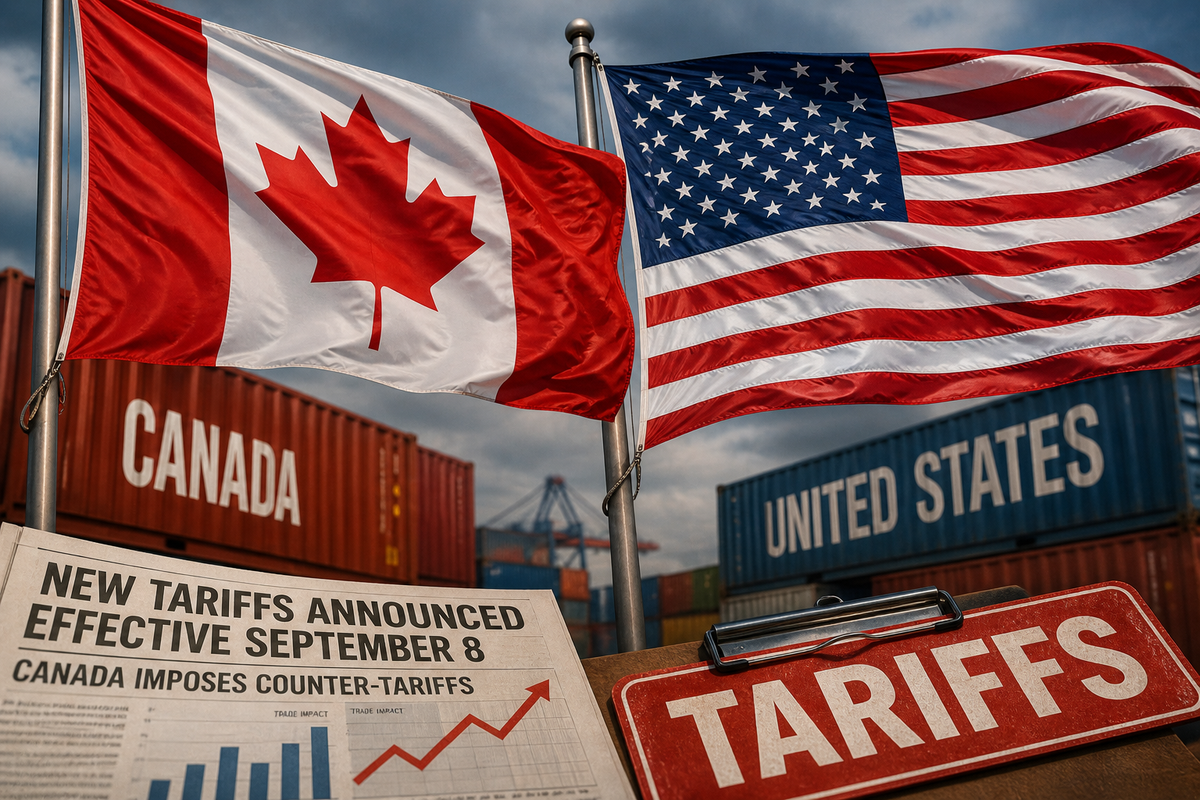
Canada has announced a new round of counter-tariffs on American goods in response to U.S. tariffs that took effect August 22. Ottawa says it will match those American measures dollar-for-dollar and rate-for-rate, placing new duties of 15%, 25% and 50% on C$27.6 billion worth of U.S. imports.
The list is broad.
Steel and aluminum products are included, but so are dairy products, appliances, agricultural equipment, paper products, plastics and electronics. Canada's government says the measures have been designed to concentrate retaliation in sectors affected by U.S. tariffs while protecting Canadian workers and businesses.
That's the government-policy explanation.
For ordinary Americans and Canadians, however, the more important question is simpler:
What happens next?
A Trade Dispute Gets More Expensive
Tariffs are taxes collected on imported goods. Governments impose them on importers, but that doesn't mean businesses simply absorb the cost.
Some will.
Others will raise prices, change suppliers, postpone investments or stop carrying certain products altogether.
That's why a tariff dispute between two deeply integrated economies can spread well beyond the industries politicians originally intended to target.
Canada and the United States don't simply sell finished products to one another. Their manufacturing systems are intertwined. Components can cross the border during production before the finished product eventually reaches a consumer.
That makes escalation particularly complicated.
Reuters reported this week that the dispute intensified after bilateral negotiations collapsed, with Canada announcing retaliatory tariffs and the United States threatening additional measures—including dramatically higher tariffs on Canadian vehicles and automotive parts beginning next year.
What began as an argument over specific trade policies is increasingly becoming a test of one of the world's largest economic relationships.
Why September 8 Matters
Canada's new tariffs aren't merely symbolic.
The government's published list contains hundreds of tariff classifications. The measures apply specifically to qualifying U.S.-origin goods and begin at 12:01 a.m. on September 8. Goods already in transit to Canada when the measures take effect are exempt.
Ottawa is also pairing the tariffs with economic assistance for Canadian businesses and workers affected by the dispute.
That combination tells us something important.
Canada isn't treating this as a short-lived political gesture.
It's preparing for economic consequences.
And businesses on both sides of the border will now have to make the same calculation: whether the dispute ends quickly enough to wait it out—or lasts long enough that supply chains, purchasing decisions and prices need to change.
The Consumer Usually Arrives Last
Trade wars tend to begin with enormous numbers.
Billions in imports. Percentage rates. National trade balances.
But eventually those numbers work their way down to something much smaller: a receipt.
A manufacturer pays more for a component. A distributor pays more for imported inventory. A retailer sees its wholesale price increase.
Somewhere along that chain, someone has to absorb the additional cost.
Sometimes it's the producer.
Sometimes it's the retailer.
And sometimes it's you.
That doesn't mean every product covered by Canada's tariffs will suddenly cost 15%, 25% or 50% more. Pricing is considerably more complicated than simply adding the tariff rate to the sticker price.
But sustained tariffs create pressure.
And the longer this confrontation lasts, the more opportunities there are for that pressure to reach consumers.
The Bigger Risk
There is another danger here that has less to do with the price of an appliance or piece of machinery.
Canada and the United States spent decades building an extraordinarily integrated trading relationship. Businesses made investment decisions based partly on the assumption that goods could move relatively predictably across the border.
Repeated tariff threats undermine that predictability.
Companies can adjust to high costs.
What they struggle with is uncertainty.
Should a factory expand?
Should a supplier sign a five-year contract?
Should a company move production?
Those decisions become harder when the rules governing cross-border trade can change dramatically within months.
Canada's economy has recently shown resilience—Reuters reported that second-quarter growth rebounded strongly—but economists are already watching whether renewed trade tensions threaten that momentum.
Where This Goes From Here
Both countries still have powerful reasons to reach an agreement.
Their economies are too connected for a prolonged trade war to be painless for either side.
But September 8 represents another step away from negotiation and toward retaliation.
Washington imposed tariffs.
Ottawa answered.
Now businesses adjust.
And consumers wait to see how much of the bill eventually reaches them.
That's the uncomfortable reality behind almost every trade war: governments announce the percentages, industries calculate the damage, and ordinary people often discover the consequences later.