Election Night Is a TV Show. Counting Votes Is Not.
Election Night is built for television drama, not final results. Here’s why changing vote totals are normal, network projections are not official, and accurate counting takes time.
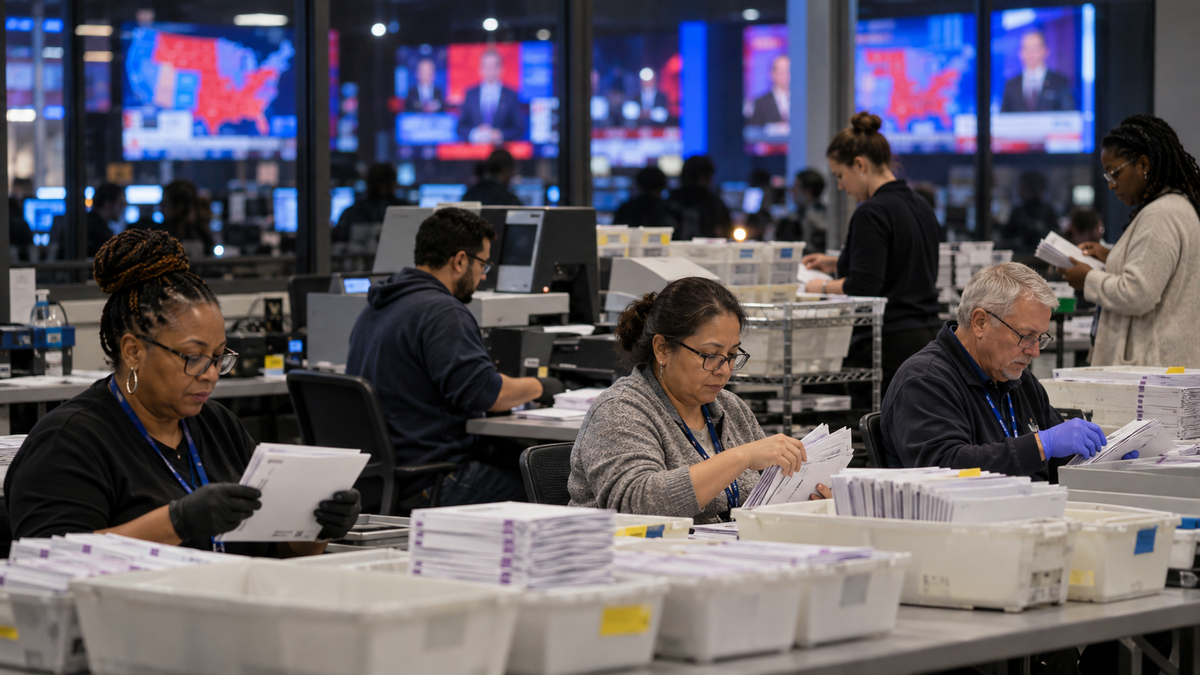
Networks race to declare winners before viewers go to bed. Election officials have a slower job: count every valid ballot and prove the numbers add up.
By Tom Mercer | The Brief
Election Night has dramatic music, glowing maps, countdown clocks, and experts pointing at counties most Americans had never heard of before dinner.
It also has one major flaw.
It encourages voters to believe an election should be finished before bedtime.
That is television’s deadline. It is not the law.
The First Results Are Never Final
The numbers shown on election night are unofficial. They change as counties report additional ballots and correct incomplete totals.
That is normal.
Americans now vote in several ways. Some vote early in person. Others vote by mail, use drop boxes, or visit a polling place on Election Day. Military and overseas ballots follow separate timelines. Provisional ballots require officials to confirm a voter’s eligibility before including them.
States also follow different rules.
Some allow election workers to verify and prepare mail ballots before Election Day. Others make them wait. Some require mailed ballots to arrive before polls close. Others accept ballots that were postmarked on time but arrive later.
A state that reports slowly is not necessarily doing anything suspicious. It may simply be following a slower law.
Changing Numbers Are Not Mysterious Votes
A candidate can lead early and fall behind later because different types of ballots are counted at different times.
Election Day votes may be reported first. Mail ballots may arrive later. A large city may release one enormous batch after smaller counties have already finished.
The order can create a dramatic shift even when every ballot was cast legally and handled according to established procedures.
A changing total deserves an explanation. It does not automatically deserve a conspiracy theory.
Election officials should tell the public how many ballots remain, which counties are still reporting, and what types of votes are being processed. When officials fail to communicate, suspicion rushes into the silence.
A Network Call Is Not a Legal Result
When a television network declares a winner, it is making a projection.
Its analysts study reported votes, turnout, historical patterns, and the number of ballots still available. If they believe the trailing candidate cannot catch up, the network calls the race.
That call has no legal authority.
States determine the winner through a canvass. Officials reconcile ballots with voter records, review provisional ballots, resolve eligible ballot problems, verify local reports, and confirm that the totals match.
Audits or recounts may follow when required by law.
Only then is the result certified.
Accuracy Is Supposed to Be Slower Than Television
Voters have every right to demand secure elections, transparent procedures, and honest explanations when mistakes occur.
They should also understand that counting carefully takes longer than updating a television graphic.
The goal is not to produce a winner before Americans go to sleep. The goal is to count every valid ballot once, reject ballots that do not meet the law, and provide a result that can withstand scrutiny.
Election Night is exciting because it feels final.
It rarely is.