
Rush Found Their New Drummer. Now Comes the Hard Part.
Rush is returning with Anika Nilles behind the kit. She isn't replacing Neil Peart—and that may be exactly why this new chapter can work.
Jack Sullivan
Entertainment Writer · The Algorithmic Journal
There are certain jobs in rock music that aren't really jobs anymore.
They're monuments.
Playing drums for Rush is one of them.
For more than four decades, Neil Peart wasn't simply the drummer behind Geddy Lee and Alex Lifeson. He was one-third of the machinery that made Rush unmistakably Rush: a technically astonishing player, the band's principal lyricist, and an almost mythic figure to generations of drummers who spent countless hours trying—and usually failing—to reproduce what he did behind the kit.
Peart died in 2020 after a private battle with brain cancer. For many fans, that seemed to close the book on Rush.
Apparently, the book wasn't quite finished.
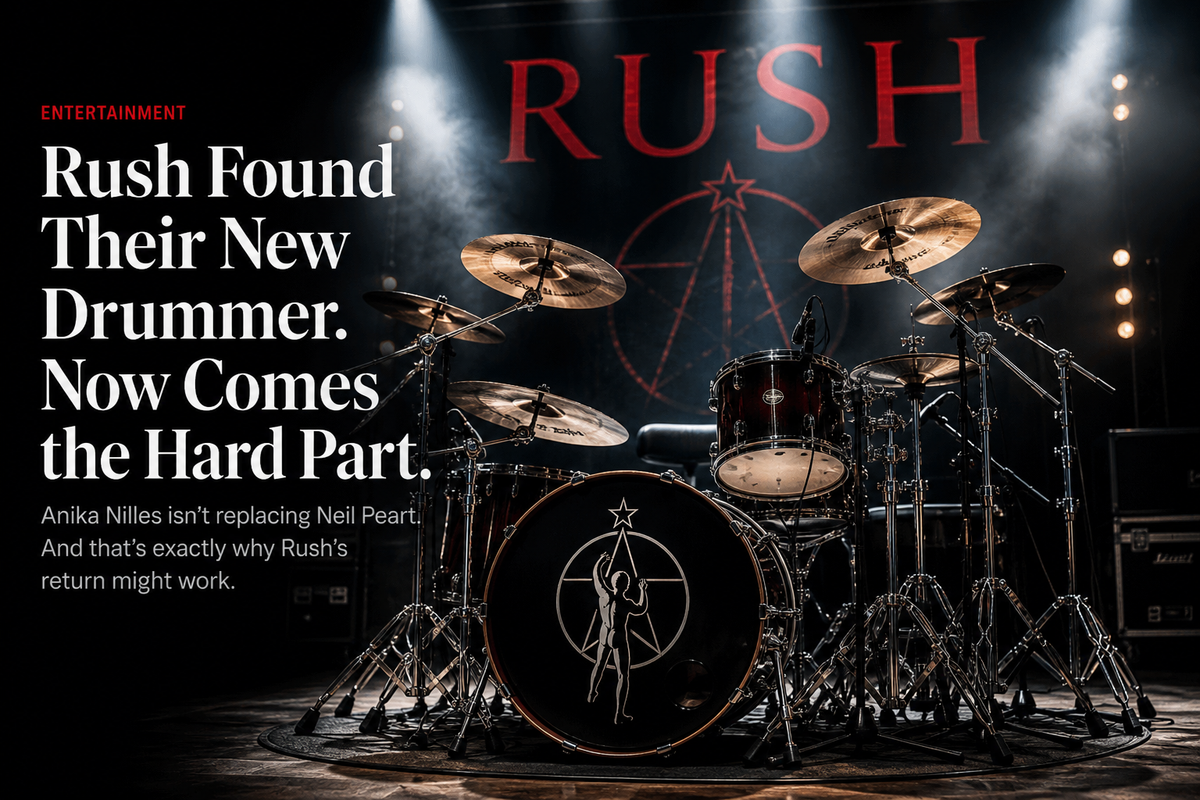
Lee and Lifeson have announced their return to the stage, and sitting behind the drum kit will be German drummer Anika Nilles.
It's a fascinating choice precisely because Nilles doesn't feel like someone hired to impersonate Neil Peart.
And that's important.
The Impossible Audition
There is no such thing as replacing Neil Peart.
Rush fans know it. Lee and Lifeson certainly know it. And Nilles undoubtedly knows it.
Trying to find a drummer who could convincingly be Peart would turn the whole enterprise into something Rush has never been particularly interested in becoming: a nostalgia act performing a museum-quality reproduction of its own past.
Nilles offers another possibility.
She's an extraordinarily technical player with the precision necessary to navigate Rush's notoriously demanding catalog, but she also brings her own musical personality. Her reputation has been built on intricate rhythmic ideas, unusual subdivisions and a modern approach to progressive drumming.
In other words, she has the chops.
But chops alone aren't enough.
Rush's music has always required something more difficult to quantify: restraint amid complexity. Peart could play passages that sounded almost architecturally designed, yet the songs rarely felt like exercises from a drum clinic.
That's the real challenge Nilles inherits.
Not playing the notes.
Making them breathe.
Rush Without Neil
There will inevitably be fans who say Rush shouldn't exist without Peart.
I understand that argument.
Some bands survive personnel changes almost effortlessly. Others are so dependent upon the chemistry of specific people that removing one fundamentally changes the identity of the group.
Rush unquestionably belongs in the second category.
But Lee and Lifeson aren't pretending otherwise.
That's what makes this return interesting.
If the surviving members had announced a permanent replacement for Peart and simply carried on as though nothing had happened, it would feel wrong. Instead, this feels more like two musicians acknowledging that they still have music left in them—and that they miss playing these songs together.
There's something deeply human about that.
Musicians don't necessarily stop being musicians because a chapter ends.
Sometimes they just have to figure out what the next chapter is allowed to look like.
A Different Kind of Rush
The smartest thing Rush can do now is resist the temptation to recreate 1981.
Nobody needs a younger Neil Peart impersonator sitting behind an enormous replica drum kit while Lee and Lifeson pretend the last several years never happened.
Let Nilles sound like Nilles.
Let Lifeson play differently.
Let Lee approach songs in ways that acknowledge where his voice is today.
Let the music age with the people playing it.
Because the interesting question isn't whether this version of Rush can reproduce the old Rush perfectly.
It can't.
The interesting question is whether something worthwhile can emerge from three musicians standing onstage together and discovering what these songs mean now.
Neil Peart's place in Rush is secure. Nothing that happens on a future stage can diminish it.
Maybe that's precisely what gives Lee and Lifeson permission to move forward.
And maybe Anika Nilles doesn't need to fill Neil Peart's shoes.
She just needs to bring her own.