What Is Inflation — and Why Does Everything Cost More?
Inflation may be slowing, but groceries, rent and everyday expenses still feel expensive. Here's what inflation actually means, why prices rise and why lower inflation doesn't necessarily mean lower prices.
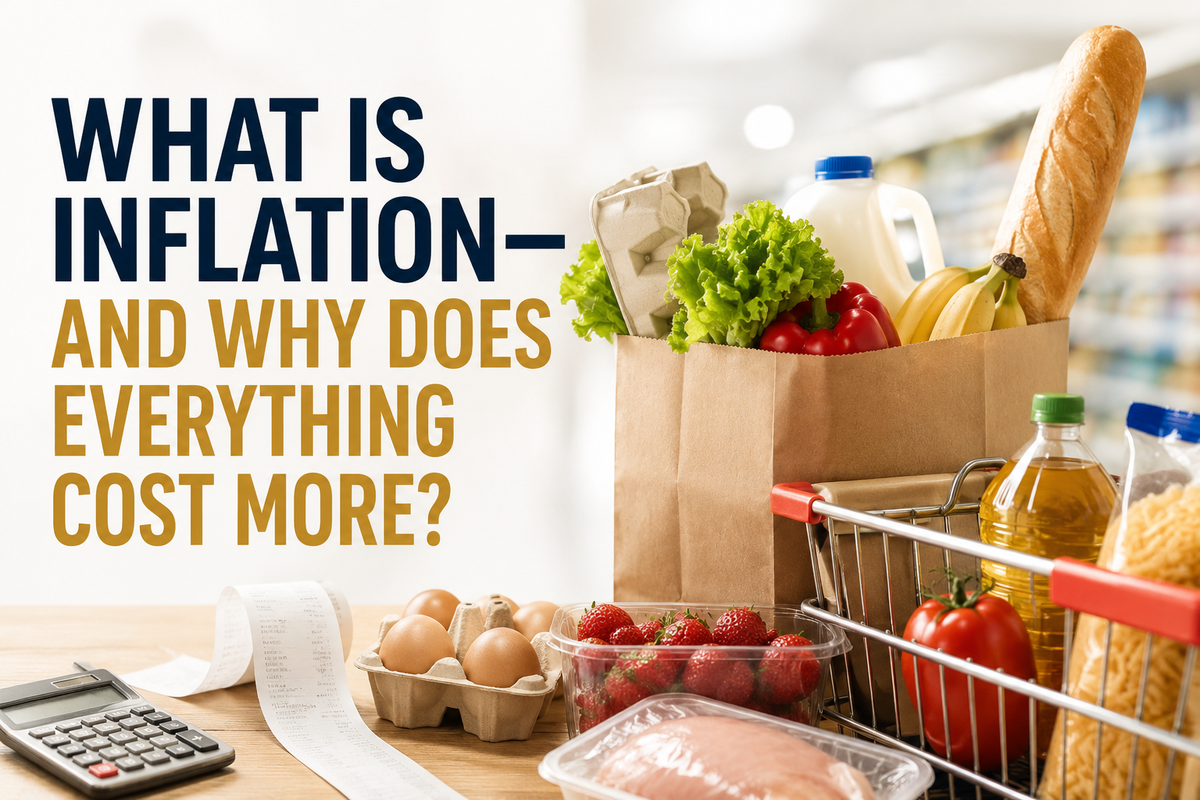
By Tom Mercer — The Brief
You walk into the grocery store and spend $80 on what feels like $60 worth of food.
Your insurance renewal arrives and the premium has gone up. Dinner costs more. Rent costs more. A routine trip to the mechanic somehow becomes a major financial event.
Then you hear on the news that inflation is “coming down.”
And you think:
Then why isn't anything getting cheaper?
The answer starts with understanding what inflation actually means.
What Is Inflation?
Inflation is a broad increase in prices across the economy over time.
One product becoming more expensive isn't necessarily inflation. If a disease wipes out part of the orange crop and orange juice suddenly costs more, that's primarily a problem with orange juice.
Inflation is different.
It happens when prices rise across many categories—food, housing, transportation, services and other things households regularly buy.
The practical result is that your money buys less.
If something cost $100 and later costs $105, you need five more dollars to buy exactly the same thing.
That's inflation from the consumer's point of view.
Why Do Prices Go Up?
There's no single cause.
Sometimes demand increases faster than businesses can supply what people want.
Imagine a car dealer has ten vehicles available but twenty people want to buy them. The dealer has little reason to offer discounts. Prices can rise because buyers are competing for limited supply.
The opposite can happen on the production side.
A manufacturer might pay more for steel, electricity, transportation or labor. A restaurant might face higher prices for ingredients, rent and wages.
Businesses don't always absorb those increases themselves.
Some of the cost gets passed along to customers.
That's why inflation can spread. The trucking company's fuel costs rise. Shipping becomes more expensive. The grocery store pays more to receive its products. Eventually some of that increase appears on the shelf.
Supply Problems Matter Too
We got a dramatic lesson in this during the COVID-19 pandemic.
Factories closed. Shipping was disrupted. Computer chips became difficult to obtain. Consumers changed what they were buying and how they were buying it.
Demand for some products surged while the systems responsible for producing and transporting those products struggled to keep up.
When lots of buyers are chasing too few goods, prices tend to rise.
Supply eventually improves, but prices don't necessarily return to where they started.
That's one reason inflation can be frustrating long after the original disruption has passed.
What Does the Federal Reserve Have to Do With It?
The Federal Reserve—the central bank of the United States—tries to maintain stable prices while also supporting a healthy labor market.
One of its most powerful tools is interest rates.
When inflation is running too high, the Fed can raise its benchmark interest rate. That tends to make borrowing more expensive throughout the economy.
Mortgages, auto loans, business financing and credit can become more costly.
The idea is to cool demand.
If people and businesses borrow and spend less aggressively, the pressure pushing prices upward can ease.
But there's a balancing act.
Slow the economy too little and inflation may remain high.
Slow it too much and you risk hurting businesses, employment and economic growth.
There is no giant LOWER PRICES button sitting on a desk at the Federal Reserve.
Here's the Part That Confuses Almost Everyone
Suppose inflation was 8 percent and falls to 3 percent.
That does not mean prices fell.
It means prices are generally rising more slowly.
Think of a car traveling 80 miles per hour that slows to 30.
It's still moving forward.
The same basic idea applies to the overall price level.
If your $4 item becomes $4.32 after an 8 percent increase, another year of 3 percent inflation doesn't send it back to $4.
It becomes roughly $4.45.
Inflation came down.
The price still went up.
For prices across the economy to actually decline, we'd be talking about deflation, which is a different economic condition altogether.
Why Does My Personal Inflation Feel Worse?
Because the official inflation rate isn't your inflation rate.
Government inflation measures track changes across a large collection of goods and services. Your household buys only some of them.
Someone whose rent jumps dramatically may feel inflation much more severely than a homeowner with a fixed-rate mortgage.
A family buying a lot of groceries experiences food increases differently from someone who eats inexpensively at home.
Someone who drives 100 miles a week cares considerably more about gasoline prices than someone working from home.
So when you hear that inflation is 3 percent, that doesn't mean everything you personally buy increased exactly 3 percent.
It's an average.
Your wallet lives in the specifics.
Will Prices Ever Go Back to What They Were?
Some will.
Individual prices rise and fall all the time. Gasoline can drop. Eggs can become cheaper. Retailers discount products. Housing markets change.
But a broad return to the prices of five or ten years ago is unlikely under normal economic conditions.
That's why wages matter so much.
Over time, incomes also need to rise. What ultimately determines whether households feel better isn't simply whether prices stop increasing rapidly.
It's whether their purchasing power can keep up.
Inflation Is Really About What Your Money Can Buy
Economic reports can make inflation sound abstract.
For households, it isn't.
It's the difference between the grocery cart you used to fill and the one you can afford today.
It's the restaurant you visit less often.
It's the rent increase that changes your monthly budget.
And it's why hearing that inflation is falling can sound disconnected from everyday life.
The next time someone says inflation is down but you look around and wonder why everything is still expensive, remember the distinction:
Lower inflation doesn't necessarily mean lower prices.
It usually means those higher prices are simply climbing more slowly.