What Is the National Debt, and Should You Be Worried?
America’s national debt has climbed into the tens of trillions of dollars—but what does that actually mean for you? Tom Mercer explains where the debt comes from, who owns it, why interest costs matter, and whether Americans should really be worried.
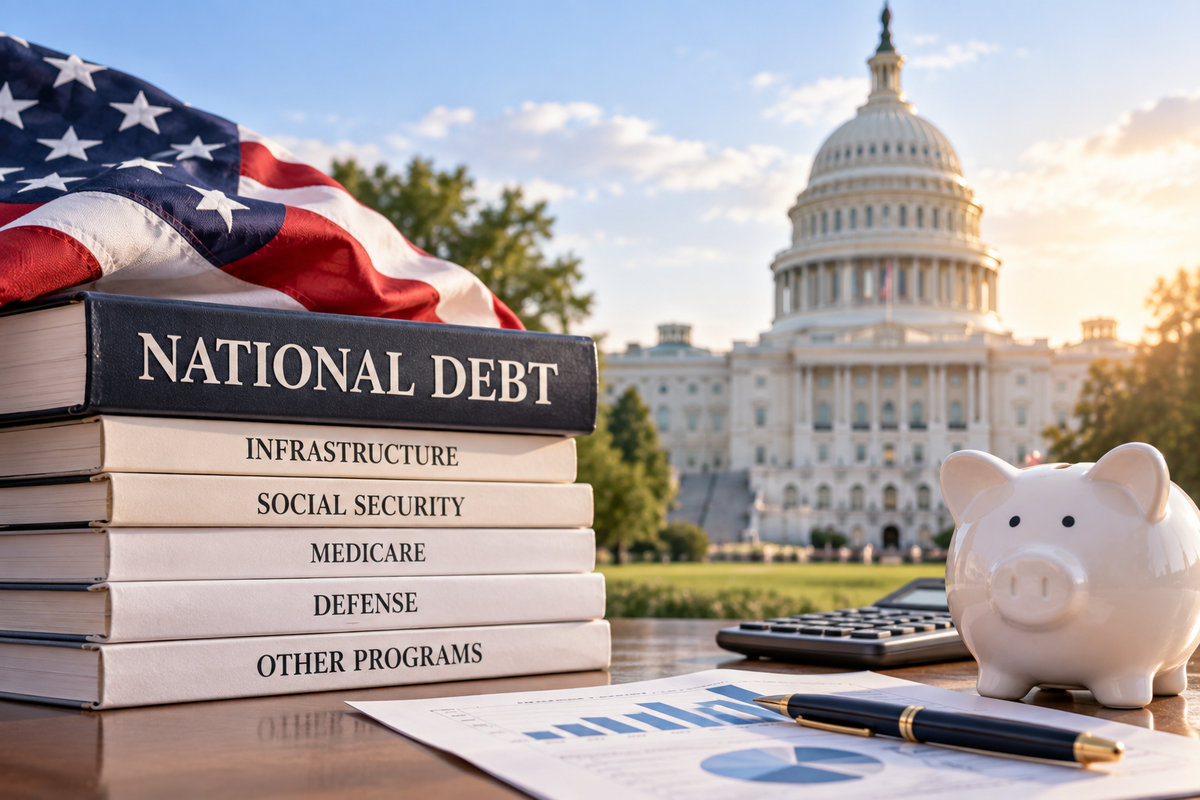
The number is enormous. But understanding what it actually means is more useful than simply being frightened by it.
By Tom Mercer | The Brief
Every so often, the national debt flashes across the news and the number is almost impossible to comprehend.
Thirty trillion dollars. Thirty-five trillion. Thirty-seven trillion.
At some point, the numbers become so large that they stop feeling like money at all. They sound more like distances between planets.
But behind those enormous figures is a fairly simple idea: for many years, the federal government has spent more money than it collects. It borrows the difference. Over time, that borrowing accumulates into the national debt.
The question isn't whether the United States has debt. It clearly does.
The more useful question is: How much does it matter?
First, the debt and the deficit aren't the same thing
These two terms are often used interchangeably, but they're different.
A budget deficit happens when the federal government spends more during a particular year than it receives in taxes and other revenue.
The national debt is the accumulation of federal borrowing over many years.
Think of it this way: if you spend $5,000 more than you earn this year and borrow the difference, that's your annual deficit. If you already owed $40,000 before doing that, the additional borrowing adds to your total debt.
For fiscal year 2026, the Congressional Budget Office projects that the federal government will spend about $7.4 trillion while collecting about $5.6 trillion, producing a deficit of roughly $1.9 trillion.
That shortfall has to be financed.
Who lends the government all that money?
This is where the national debt is sometimes misunderstood.
The government doesn't walk into a gigantic bank and ask for a loan.
The U.S. Treasury sells securities, Treasury bills, notes and bonds. Investors buy them, effectively lending money to the federal government in exchange for repayment with interest.
Those investors include individuals, banks, pension funds, mutual funds, insurance companies, the Federal Reserve, foreign investors and governments, and many other institutions.
There's also money the federal government owes to its own accounts.
At the end of fiscal year 2025, total federal debt stood at approximately $37.6 trillion. About 80 percent was held by the public, while roughly 20 percent represented debt the government owed internally to government accounts.
That's why you'll sometimes see different "national debt" numbers. People may be talking about total federal debt or specifically about debt held by the public.
Is having national debt automatically bad?
No.
Governments borrow for many of the same reasons businesses and individuals do: sometimes spending money today can help deal with an emergency or finance something valuable over many years.
Wars, recessions, natural disasters and public-health emergencies can cause government borrowing to rise sharply. Borrowing can also finance long-term investments such as infrastructure.
So the existence of government debt isn't necessarily evidence that something has gone terribly wrong.
The problem comes when debt consistently grows faster than the country's ability to support it.
And that's where economists and federal budget watchdogs are increasingly concerned.
The important number isn't just trillions of dollars
A $1 million mortgage would be catastrophic for someone earning $50,000 a year.
For someone earning $20 million a year, it might be quite manageable.
Debt works similarly for countries.
That's why economists often compare federal debt with the size of the overall economy, gross domestic product, or GDP.
In 2026, CBO projects debt held by the public at approximately 101 percent of GDP. Under current-law projections, it rises to 120 percent by 2036, exceeding the post-World War II record.
The Government Accountability Office has reached the same basic conclusion: the current trajectory is not sustainable over the long term because federal debt is growing faster than the economy.
That's more meaningful than simply watching a giant debt clock tick upward.
Then there's the interest bill
This may be the part of the debt discussion that matters most.
Borrowed money isn't free.
The government pays interest to people and institutions that own Treasury securities. As the amount borrowed grows, and as older debt is refinanced at prevailing interest rates, the cost of servicing that debt can become enormous.
In fiscal year 2025, interest on the federal debt reached approximately $1.2 trillion. GAO reports that interest on debt held by the public nearly doubled between fiscal years 2022 and 2025.
That matters because money spent paying interest can't simultaneously be spent on something else.
CBO projects net interest costs will continue growing relative to the economy during the coming decade.
Debt therefore creates something that isn't always obvious when politicians argue about spending: tomorrow's taxpayers have to pay for yesterday's borrowing before deciding what to do with today's money.
So are we headed for bankruptcy?
That's where the conversation often becomes unnecessarily dramatic.
The United States federal government isn't a household, and its finances don't work exactly like yours or mine. It issues debt in a currency it controls, has enormous taxing capacity and operates the world's largest national economy.
That doesn't mean debt can grow without consequences.
It means predictions such as "America is about to go bankrupt" oversimplify a complicated issue.
The more realistic danger is gradual.
Persistently rising debt can put upward pressure on borrowing costs, consume a larger share of federal spending through interest payments, reduce the government's flexibility during future emergencies and leave policymakers with increasingly difficult choices about taxes and spending. GAO warns that growing federal debt can eventually affect ordinary Americans through higher borrowing costs and weaker economic growth.
That's less dramatic than a sudden national bankruptcy.
It may also be more important.
Why doesn't somebody just fix it?
Because every solution involves something people don't particularly like.
Broadly speaking, reducing future deficits requires some combination of:
spending less, collecting more revenue, or achieving stronger economic growth.
And the largest parts of the federal budget aren't obscure programs most Americans have never heard of. Major long-term spending pressures include Social Security, Medicare and rising interest costs.
That turns a mathematical problem into a political one very quickly.
Cut spending? Which spending?
Raise revenue? From whom?
Change Social Security or Medicare? How?
Those questions affect millions of people, which is why politicians can agree that the debt is a problem while strongly disagreeing about what should be done about it.
Should you be worried?
Concerned is probably a better word.
The national debt isn't a credit-card bill that suddenly arrives in every American's mailbox. Nor does reaching some enormous round number mean the economy collapses the following morning.
But dismissing it because previous warnings didn't result in catastrophe isn't particularly sensible either.
The United States is running large deficits even outside a major recession or national emergency. Debt is projected to grow faster than the economy, while interest consumes an increasing amount of federal resources.
Those are genuine problems.
The national debt doesn't need panic.
It needs something considerably less exciting and considerably harder to achieve:
a long-term willingness to make choices.
And unfortunately, that's one thing Washington has been borrowing too.