Why NFL Clock Management Is Harder Than It Looks
Clock management looks simple from the couch. On an NFL sideline, every second depends on timeouts, field position, down and distance, and what must happen several plays later.
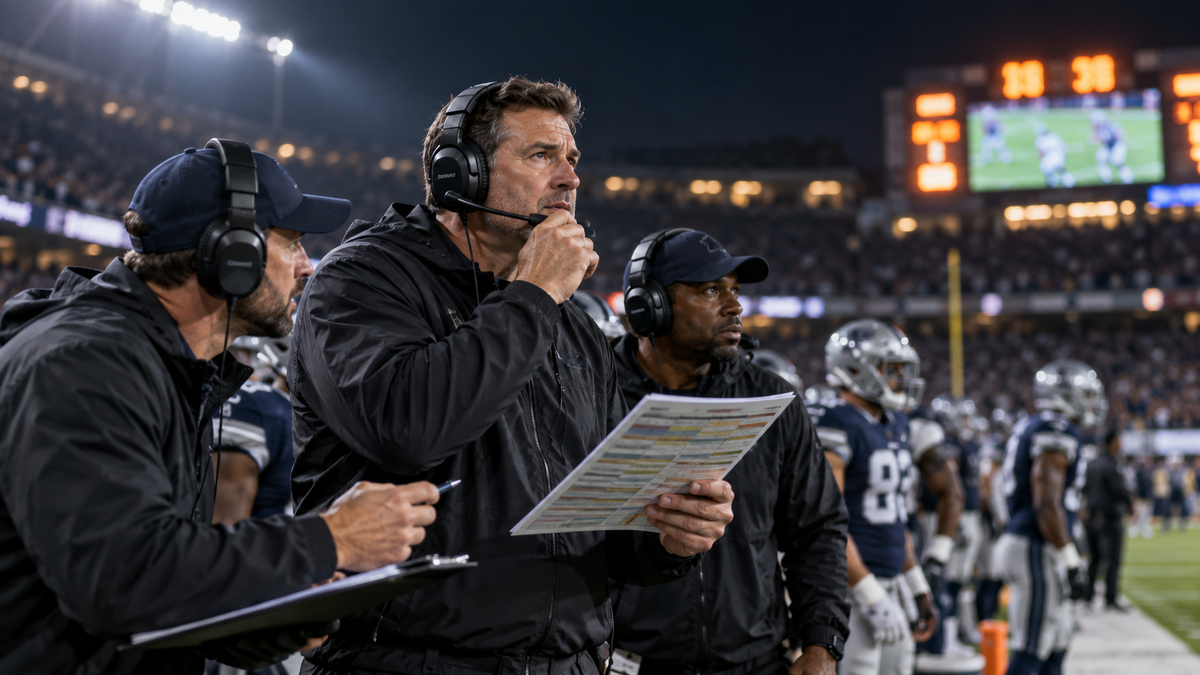
Managing the clock seems simple when you are watching from the couch. On an NFL sideline, one decision can depend on the score, field position, timeouts, down and distance—and what must happen three plays later.
By Marcus "Marc" Reynolds | Beyond the Score
Every football fan has managed the clock perfectly.
From the couch, it is easy.
Call the timeout. Spike the ball. Run out of bounds. Stop wasting time. Why is the coach standing there while 20 perfectly good seconds disappear?
Then the game ends, the losing coach walks into a press conference and explains a sequence that still makes no sense to half the audience.
Some clock-management failures deserve the criticism. Coaches have burned timeouts they desperately needed, allowed precious seconds to vanish and reached the end of games with no clear plan.
But managing an NFL clock is considerably harder than reading the large numbers displayed at the bottom of the television screen.
New to the game? Start with TAJ’s beginner’s guide to how football works.
The clock is not merely counting down. It is changing the value of every decision on the field.
The Clock Does Not Always Behave the Same Way
An NFL game has both a game clock and a play clock, and each follows its own rules.
Teams generally receive 40 seconds to begin the next play after the previous one ends. After certain administrative stoppages, the play clock may begin at 25 seconds instead.
The game clock can stop for incomplete passes, timeouts, scores, penalties, changes of possession and several other situations. Running out of bounds can stop it too—but whether it remains stopped depends on when the play occurs.
Outside the final two minutes of the first half and the final five minutes of the second half, the clock normally restarts after an out-of-bounds play once the officials spot the ball and signal it ready for play.
That detail surprises people every Sunday.
A receiver can step out with eight minutes remaining, and the clock shown on television will briefly stop. By the time the offense reaches the line, however, it may be running again.
The rules also include automatic two-minute warnings in the second and fourth quarters, possible 10-second runoffs late in a half and different timing procedures following reviews or certain penalties.
A coach must know which rule applies before deciding whether the next play should attack the sideline, the middle of the field or the end zone.
Timeouts Are a Form of Currency
Each team receives three timeouts per half. Their value rises dramatically as the game approaches its final minutes.
Using a timeout early may prevent a delay-of-game penalty, fix a defensive mismatch or rescue a play when the offense is confused. That can be worthwhile.
It also means the timeout will not be available later.
A trailing team with three timeouts can force an opponent to keep playing rather than simply kneeling. A team with none may watch the final minutes disappear while the opposing offense barely moves the ball.
This creates decisions that look strange in isolation.
A coach may allow 25 seconds to run before calling a timeout because stopping the clock immediately would leave too much time for the opponent after a potential score. Another coach may decline to use a timeout on defense because preserving it for the offense creates more value.
The goal is not always to save the greatest possible number of seconds.
The goal is to preserve the right number of seconds for the situation the team hopes to create.
Sometimes a Successful Play Creates a Problem
Late-game offense is filled with tradeoffs.
A completion over the middle may gain 15 yards but force the offense to rush to the line while the clock continues running. An incomplete pass stops the clock but gains nothing. A runner fighting for three additional yards may waste more time than those yards are worth.
Even scoring can become complicated.
A team trying to take the lead may want to consume enough time that its opponent cannot answer. A defensive player returning a turnover might be better off falling to the ground instead of scoring if possession alone allows the team to end the game.
These choices violate the most basic instinct in sports: gain every yard and score whenever possible.
Clock management sometimes requires players to think about the game that will exist after the current play rather than maximizing the current play itself.
The Sideline Is Solving Several Problems at Once
Television gives viewers a clean overhead view, a visible game clock, replay angles and commentators discussing the available options.
A head coach is standing among players, assistants, officials, substitutions and crowd noise while communicating through a headset and preparing for the next decision.
The coach is not working alone. Assistants may monitor timeouts, replay possibilities and situational strategy. The quarterback may call plays at the line based on the defense. Officials can change the ball’s placement or adjust the clock after a conference.
But the head coach remains responsible for the final choice.
The best teams prepare for these situations repeatedly. They practice two-minute drives, end-of-half possessions and the strange scenarios that appear only once or twice a season.
Preparation does not eliminate mistakes. It prevents the sideline from encountering every problem for the first time while 70,000 people are screaming.
The Biggest Mistake Is Often Hesitation
A questionable decision can still succeed when it is made quickly.
Indecision is harder to survive.
If a coach spends 15 seconds deciding whether to call a timeout, the team can lose both the time and the timeout. If the offense reaches the line without knowing whether it intends to spike the ball or run a play, confusion consumes the very seconds it is trying to save.
Good clock management begins before the clock becomes urgent.
Teams should know whether they will use a timeout after the next play, whether the middle of the field remains available and how much time they need for a final field-goal attempt.
That does not make every decision obvious. It makes the decision immediate.
Fans will continue managing the clock from the couch, where the view is excellent and the headset never malfunctions.
Sometimes we will even be right.
But true clock management is not simply knowing how much time remains. It is knowing what the next several plays must accomplish before the current one has ended.