Why NFL Players Keep Running Across the Formation Before the Snap
Pre-snap motion may look like decoration, but it helps NFL offenses reveal coverage, improve blocking angles, and force defenders to make complicated decisions in seconds.
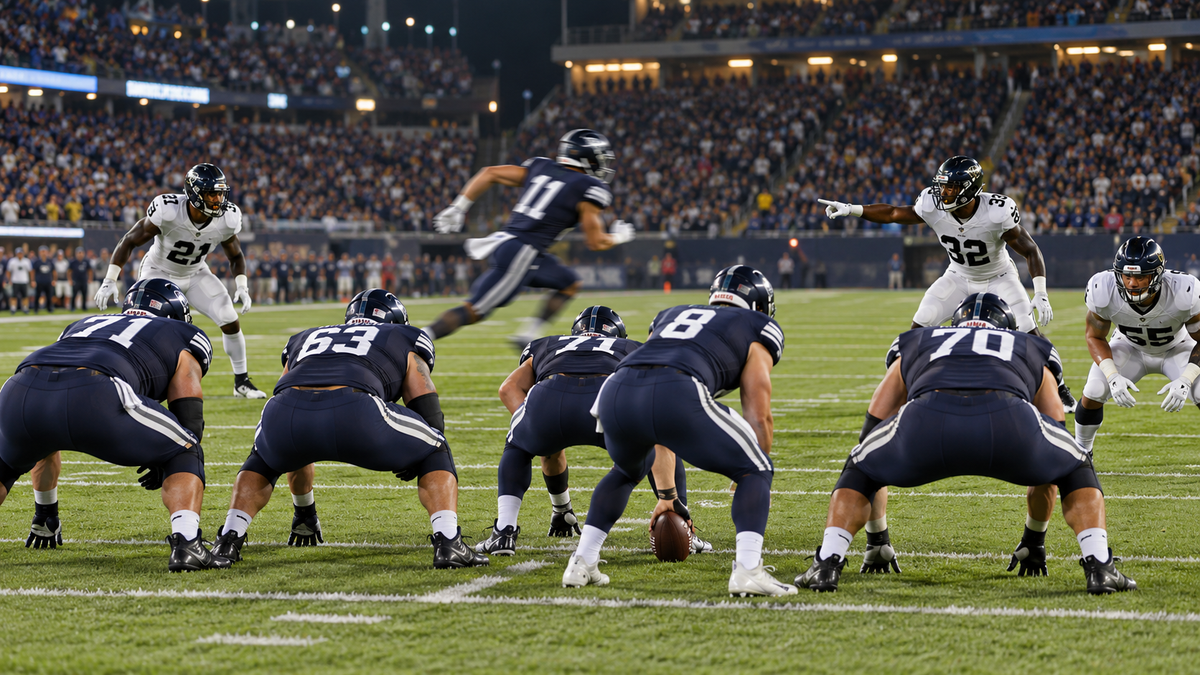
The movement may look like decoration. In modern NFL offenses, it can reveal coverage, create better blocking angles, and force an entire defense to make decisions in seconds.
By Marcus "Marc" Reynolds | Beyond the Score
Before the ball is snapped, a receiver suddenly races across the formation. A running back moves from one side of the quarterback to the other. A tight end begins in the slot and finishes beside an offensive tackle.
Then the play starts somewhere else entirely.
To a casual viewer, all that movement can look unnecessarily complicated. Why make a player sprint from one side of the field to the other if he is not even going to receive the ball?
Because motion is often doing important work before the play officially begins.
New to the game? Start with TAJ’s beginner’s guide to how football works.
Motion Can Reveal the Defense
One of the most valuable things motion provides is information.
If a receiver moves across the formation and a defender follows him, the offense may suspect the defense is playing man-to-man coverage. If defenders remain in their areas and pass responsibility for the receiver to someone else, the defense may be playing zone.
That does not give the quarterback a complete answer. Modern defenses are skilled at disguising coverage and changing their assignments after the snap.
Still, even a small clue can help.
The quarterback may discover which defender is responsible for a particular receiver. He may notice a safety moving closer to the line. He may recognize that the defense is preparing to blitz from one side.
Motion forces the defense to respond, and every response reveals something.
It Changes the Geometry of the Play
Football is partly a contest of angles.
A blocker who begins directly in front of a defender may struggle to move him. If motion forces that defender to shift even one or two steps, the blocker may suddenly have a better path.
The same is true in the passing game.
A receiver who starts from a stationary position must accelerate after the snap while a defender is already watching him. A receiver moving laterally can enter the play with momentum and may be more difficult to jam at the line of scrimmage.
Motion can also move a defender away from the area the offense intends to attack.
A receiver may sprint toward one sideline while the quarterback hands the ball to a running back going in the opposite direction. The moving receiver never touches the ball, but his speed may pull a linebacker or safety just far enough out of position to create a running lane.
The Threat Matters Even Without the Ball
Jet motion is one of the most recognizable examples.
A fast receiver races behind the quarterback just before the snap. The quarterback can hand him the ball, flip it forward, fake the exchange, or ignore him completely.
The defense must respect every possibility.
If defenders overreact to the moving receiver, the offense can attack the space they abandoned. If they ignore him, the quarterback may give him the ball and allow him to reach the edge at full speed.
The same movement can support several different plays. That allows an offense to look complicated while asking its own players to execute familiar concepts.
For a defense, however, every variation creates another possibility that must be considered immediately.
Motion Tests Communication
A defense can begin a play with every assignment perfectly understood. Motion can force those assignments to change.
Two defenders may need to exchange responsibility for receivers. A linebacker may need to move into a different gap. A safety may need to adjust the coverage while communicating with teammates in a stadium filled with noise.
One player who misses that message can create an open receiver or an unblocked running lane.
This is why offenses often use motion against young defenders, recently assembled units, or teams that have struggled with communication. The movement is not merely trying to outrun the defense. It is trying to make the defense think quickly and coordinate correctly.
There Are Rules to the Movement
NFL offenses cannot move every player however they choose.
Multiple offensive players can shift positions before the snap, but they must become set again under the league’s timing requirements. Only one eligible player may remain in motion when the ball is snapped, and that player cannot be moving forward toward the opponent’s goal line.
That distinction separates a legal motion from an illegal shift or illegal motion penalty.
The restrictions matter because motion creates a genuine advantage. Allowing several receivers to charge forward before the snap would give the offense something resembling a running start against stationary defenders.
Motion Is a Tool, Not a Magic Trick
Pre-snap movement does not automatically make an offense successful.
Poorly timed motion can create penalties. It can reveal the offense’s intentions. It can consume precious seconds on the play clock or make the quarterback’s job more complicated.
Defenses also study tendencies. If a team repeatedly uses the same motion before the same play, defenders may recognize what is coming.
The best offenses avoid that problem by making several plays look alike. The same receiver may cross the formation before a run, a short pass, a deep shot, or a play-action fake.
Next time a player begins moving before the snap, do not watch only where he goes.
Watch what the defense does because he moved.
That reaction may explain the entire play before the ball ever leaves the ground.