How Does Football Actually Work? A Beginner’s Guide to the Game
Football can seem confusing if you didn’t grow up watching it. Here’s a simple beginner’s guide to downs, scoring, offense, defense, and how the game actually works.
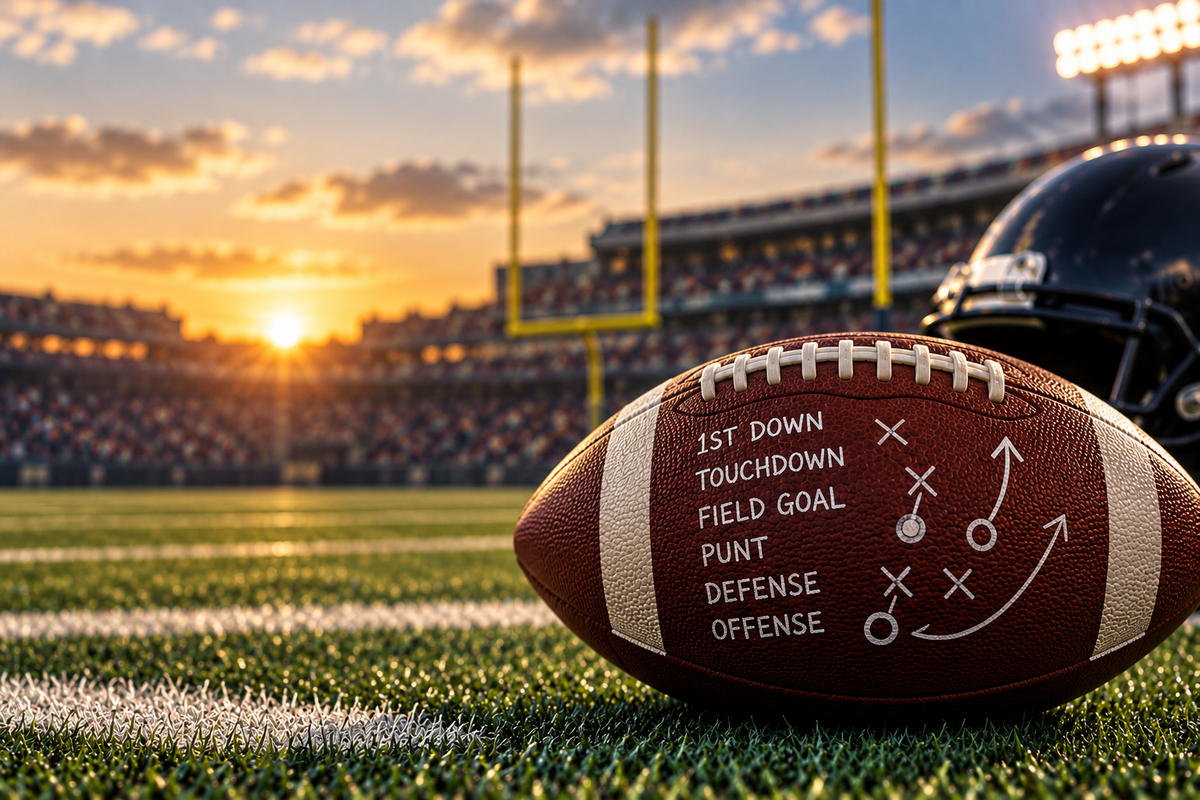
By Marcus "Marc" Reynolds | Beyond the Score
Football makes perfect sense if you grew up watching it.
If you didn't, it can look like 22 very large people running into each other while everyone around you somehow knows whether what just happened was brilliant, terrible or illegal.
Then somebody starts yelling about third-and-seven.
Don't worry.
Football is considerably easier to understand once you know what the two teams are actually trying to accomplish.
The Entire Game in One Sentence
One team has the football and tries to move it down the field and score.
The other team tries to stop them.
That's football.
Everything else—the downs, punts, field goals, penalties, play calls and guys wearing headsets—is built around that basic idea.
Offense and Defense
The team with the ball is the offense.
Its job is to move the football toward the opponent's end zone and score points.
The other team is the defense.
Its job is to stop that from happening and, ideally, take possession of the ball.
Each team has 11 players on the field at a time.
When possession changes, the roles change too. The team that was playing defense sends out its offense, while the other team's defense comes onto the field.
What's a Down?
This is the concept that unlocks football for most new fans.
The offense gets four attempts, called downs, to advance the ball at least 10 yards.
Suppose a team begins at its own 25-yard line.
That's 1st-and-10.
If it gains four yards on the first play, the next situation becomes 2nd-and-6 because it's the second down and six yards remain to reach the required 10.
Gain another three yards?
Now it's 3rd-and-3.
If the offense reaches or passes the required distance, it earns a first down and gets a fresh set of four downs.
That's why you'll hear fans yelling:
“FIRST DOWN!”
It means the offense gets to start the process again.
So Why Do Teams Punt?
Technically, an offense can use all four downs trying to gain those 10 yards.
But there's a catch.
If it fails on fourth down, the opposing team gets the ball at that spot.
That's dangerous.
So when teams reach fourth down and are too far away to attempt a field goal, they often punt.
The punter kicks the ball far down the field.
Yes, you're voluntarily giving the other team the football.
But you're making them start much farther away from your end zone.
It's basically saying:
“You can have it, but you're going to have to work for it.”
How Do You Score?
There are several ways, but beginners really need to know four.
A touchdown is worth six points. This happens when a player gets the ball into the opponent's end zone.
After a touchdown, the team usually attempts an extra point, worth one point, although it can instead try a play for two points.
A field goal is worth three points. Instead of trying to reach the end zone, the kicker attempts to kick the football through the uprights.
A safety is worth two points and occurs in certain situations when the offense is responsible for the ball becoming dead in its own end zone.
If you're just learning the game, don't worry much about safeties yet.
Touchdowns and field goals will account for most of the scoring you'll see.
What Happens on an Actual Play?
Before each play, the offense gathers—or communicates—to decide what it wants to do.
The players line up.
The quarterback usually receives the ball from the center when it is snapped.
Then the offense generally does one of two things.
It can run the ball, usually by handing it to a running back.
Or the quarterback can pass it to an eligible receiver.
Meanwhile, the defense is trying to tackle the player carrying the ball, prevent receivers from catching passes, pressure the quarterback or create a turnover.
When the ball carrier is tackled, goes out of bounds, a pass falls incomplete or something else ends the play, everybody resets.
Then they do it again.
That's one reason football feels different from sports like basketball or hockey.
It's not continuous action.
Football is a series of short, highly organized plays followed by resets.
Who Are All Those Players?
You don't need to memorize every position to understand your first game.
The quarterback generally directs the offense. Running backs carry the ball. Wide receivers catch passes. Offensive linemen protect the quarterback and create room for runners.
On defense, linemen attack up front, linebackers operate behind them, and cornerbacks and safeties help defend against passes.
We've put together a separate beginner-friendly guide explaining every major football position and what each player actually does.
Once you understand those positions, the game becomes even easier to follow.
What Is a Turnover?
A turnover is when the team with the ball loses possession to the opponent.
Two common examples are an interception, when a defensive player catches a pass intended for the offense, and a fumble, when a player loses control of the football and the opposing team recovers it.
Turnovers matter enormously because possession is valuable.
You've just gone from trying to score to watching the other team try to score against you.
This is usually when the people sitting next to you become considerably louder.
What About All the Penalties?
Ignore most of them at first.
Seriously.
You'll gradually learn holding, offsides, pass interference, false starts and the rest.
For your first few games, you only need to know this:
There are rules governing where players can line up, when they can move, how they can block and tackle, and what they can do to opponents.
Break one and an official may throw a yellow flag.
The referee announces the penalty and explains what happens next.
You don't need to understand every rule to enjoy the game.
Plenty of people who have watched football for 40 years still yell at the television about them.
Now Watch the Game Differently
The next time you watch football, forget the complicated formations and terminology.
Just ask four questions:
Who has the ball?
What down is it?
How many yards do they need?
Where are they on the field?
If you can answer those four questions, you understand what's happening.
The rest comes surprisingly quickly.
When you are ready for the next layer, TAJ also explains pre-snap motion, clock management, and the prevent defense.
Soon you'll recognize when a team should punt, when it might attempt a field goal and why everyone gets nervous on third down.
And eventually you'll find yourself saying something like:
“They're seriously going for it on fourth-and-two?”
At that point, it's probably too late for you.
You're a football fan.