Every Football Position Explained for People Who Don’t Speak Football
Quarterback, linebacker, safety, tight end—what does everyone actually do? Here's a beginner-friendly guide to football positions for people who don't speak football.
By Marc Reynolds — Beyond the Score
Football can be intimidating if you didn’t grow up watching it.
Twenty-two players are running around. Coaches are yelling into headsets. The announcer says something about a nickel package, a slot receiver and an edge rusher—and everyone around you nods like those are perfectly normal things to say.
Meanwhile, you're still trying to figure out why that enormous guy is allowed to tackle people but isn't allowed to catch the ball.
So forget the complicated terminology for a few minutes.
At its simplest, football is one team trying to move the ball down the field while another team tries to stop them.
And every player has a job.
Here are the positions you need to know.
If downs, scoring, and field position still feel unfamiliar, start with TAJ’s beginner’s guide to how football works.
Offense: The Team With the Ball
The offense's goal is simple: score points.
They have four attempts—called downs—to move the ball at least 10 yards. If they succeed, they get another four.
Here are the people responsible for making that happen.
Quarterback (QB)
Think of the quarterback as the director of the offense.
He receives the ball at the beginning of most plays and decides where it goes next. He might throw it to a receiver, hand it to a running back or occasionally run with it himself.
Quarterbacks also communicate plays and read what the defense is doing.
That's why quarterbacks get so much attention. Nearly every offensive play runs through them.
Running Back (RB)
The running back is exactly what the name suggests.
His primary job is taking the ball from the quarterback and running with it.
Running backs can also catch passes and help protect the quarterback from defenders.
They're often smaller than linemen but need an unusual combination of speed, strength and the willingness to run directly toward very large people who would like to flatten them.
Wide Receiver (WR)
Wide receivers are the offense's primary pass catchers.
They line up farther from the ball and run predetermined paths called routes. The quarterback tries to throw the ball to a spot where the receiver can catch it.
Great receivers need speed, good hands and precise timing.
Tight End (TE)
A tight end is part receiver and part offensive lineman.
On one play, he might block a defender.
On the next, he might run downfield and catch a pass.
That versatility makes good tight ends especially valuable—and occasionally a nightmare for defenses.
Offensive Line
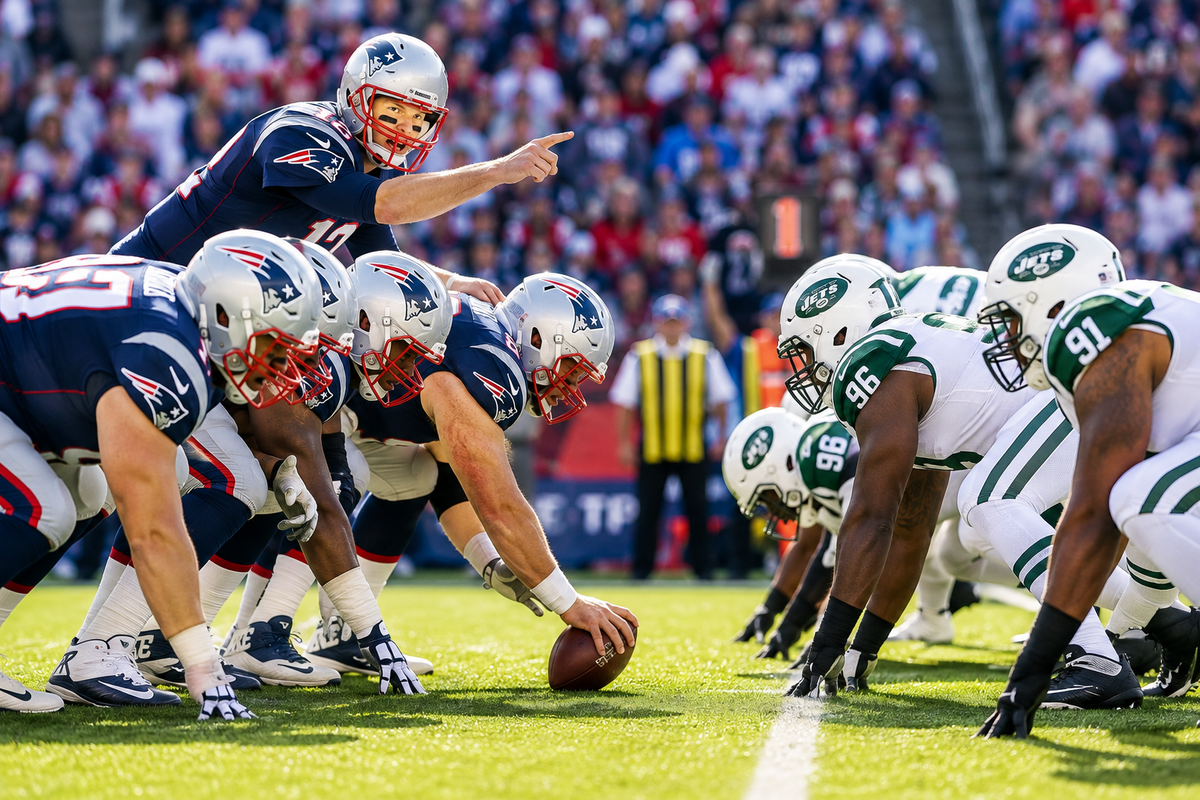
Those five enormous players standing in front of the quarterback?
They're the offensive line.
The center snaps the ball to begin the play. Guards line up beside the center, and tackles line up on the outside.
Their job is to protect the quarterback when he throws and create openings for running backs.
They don't get many highlights, but without a decent offensive line, the quarterback spends Sunday afternoon running for his life.
Defense: Stop the Other Guys
The defense has the opposite objective.
Stop the offense from moving the ball and, whenever possible, take it away from them.
Defensive Line
Defensive linemen line up opposite the offensive line.
Their job is to fight through blockers, stop running plays and pressure the quarterback.
Some specialize in clogging up the middle. Others attack from the outside.
If one reaches the quarterback before he can throw and tackles him behind the line of scrimmage, that's a sack.
Linebacker (LB)
Linebackers play behind the defensive line and have one of football's most varied jobs.
They might tackle a running back, cover a receiver, rush the quarterback or react to wherever the ball goes.
Think of them as the defense's all-purpose problem solvers.
Cornerback (CB)
Cornerbacks primarily defend wide receivers.
When a receiver runs downfield hoping to catch a pass, there's usually a cornerback nearby trying to make sure that doesn't happen.
Cornerbacks need speed because they're often running backward while trying to keep up with some of the fastest players on the field.
That seems unfair because it is.
Safety (S)
Safeties usually line up deeper than the rest of the defense.
They're the last line of protection when a play gets past everyone else.
Safeties also help defend passes and may move closer to the line when the defense expects a running play.
If the cornerbacks are the doors, safeties are the alarm system behind them.
Special Teams: The Kicking People
Whenever the ball is kicked, you're generally watching special teams.
Kicker (K)
The kicker handles field goals and extra points and often kicks the ball to the opposing team after a score.
A field goal is worth three points.
And yes, an entire game can come down to one person kicking an oddly shaped ball between two yellow posts while tens of thousands of people scream at him.
No pressure.
Punter (P)
If an offense reaches fourth down and doesn't think it can safely gain the yards needed for another first down, it may punt.
The punter kicks the ball high and far downfield, forcing the opponent to begin its next possession farther away from the end zone.
It's essentially football's version of:
“Fine. You can have the ball, but you're getting it way over there.”
What About All the Other Positions?
Football gets more complicated from here.
There are slot receivers, fullbacks, nose tackles, edge rushers, nickelbacks, long snappers, return specialists and plenty of formations that change where everyone lines up.
You don't need to learn all of that to enjoy a game.
Start with the basics:
Quarterback: runs the offense.
Running back: runs with the ball.
Receiver: catches passes.
Offensive line: protects and blocks.
Defensive line: attacks the offense up front.
Linebacker: does a little of everything.
Cornerback: covers receivers.
Safety: protects the back of the defense.
Kicker: kicks for points.
Punter: kicks for field position.
Once you can identify those groups, football suddenly starts looking considerably less chaotic.
You'll begin seeing the structure underneath all that movement.
And before long, you'll be sitting on the couch complaining about the offensive coordinator's third-down play call like the rest of us.
Congratulations. Now you speak football.